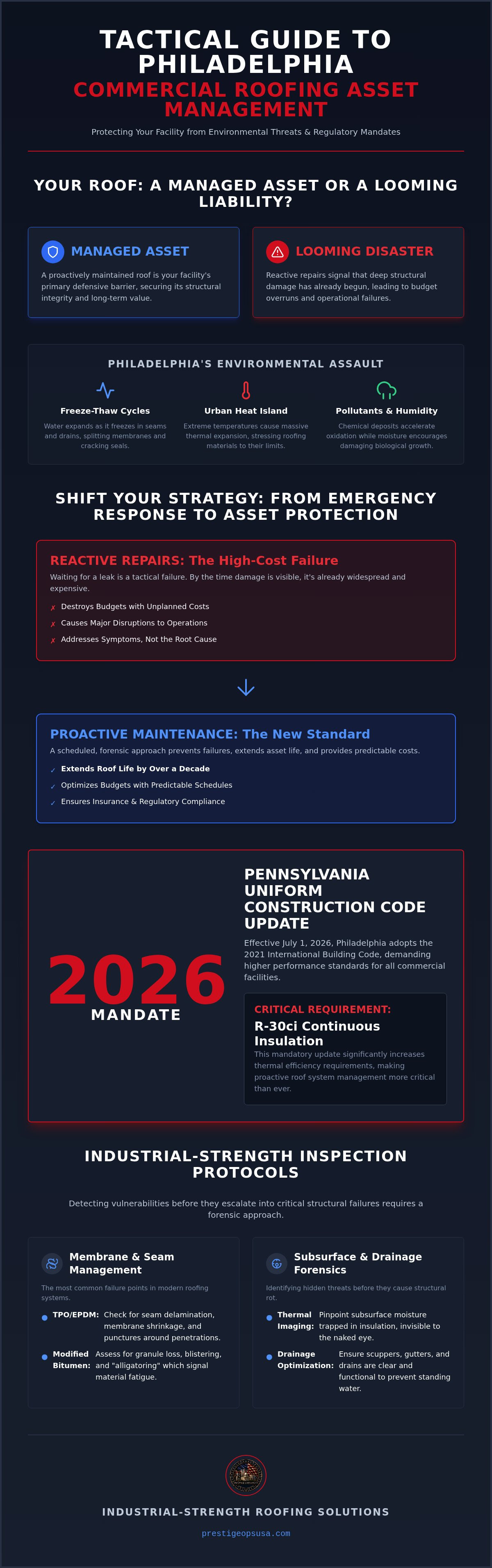
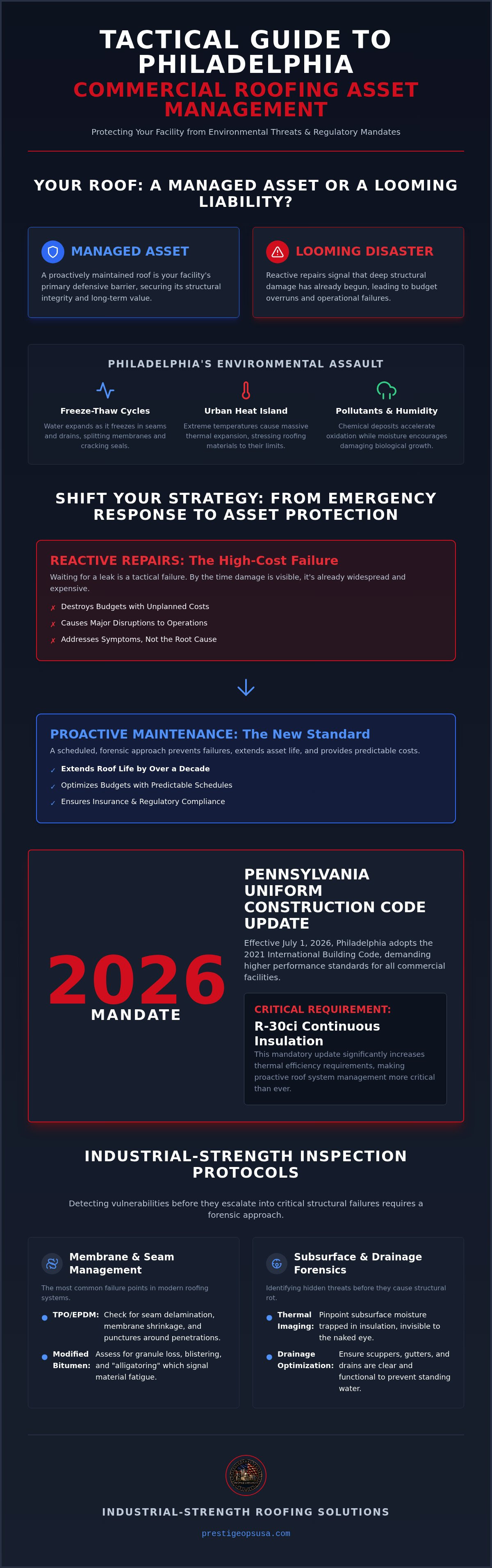
In Philadelphia, your commercial roof is either a managed asset or a looming financial disaster. The city's extreme freeze-thaw cycles and the 2026 update to the Pennsylvania Uniform Construction Code demand a higher standard of commercial exterior maintenance Philadelphia operators can no longer ignore. Waiting for a leak to appear is a tactical failure. By then, the structural damage is often already deep. You know that reactive repairs destroy budgets and disrupt operations. It's time to shift from emergency response to industrial-strength asset protection.
You need a partner who understands the logistical complexity of urban roofing systems and the precision required by the new 2021 International Building Code standards. This article outlines tactical protocols designed to extend your roof’s lifecycle and ensure your facility meets the R-30ci insulation requirements effective this year. We'll detail how to implement a predictable maintenance schedule that secures your building’s integrity. You will learn to document your roof's condition to satisfy aggressive insurer scrutiny and protect your property’s long-term value.
Key Takeaways
- Understand why the roofing system serves as the primary defensive barrier in the building envelope and how its failure compromises the entire asset.
- Implement forensic inspection protocols for TPO, EPDM, and modified bitumen systems to detect vulnerabilities before they escalate into critical structural failures.
- Optimize your budget by shifting from high-cost emergency repairs to scheduled commercial exterior maintenance Philadelphia programs that can extend roof life by over a decade.
- Utilize a 2026-ready checklist to navigate Philadelphia’s specific climate challenges, including extreme freeze-thaw cycles and updated drainage requirements.
- Leverage tactical forensic walk-throughs and industrial-strength logistics to maintain documented structural integrity for insurance compliance and property valuation.
The Critical Role of Roofing in Philadelphia Commercial Exterior Maintenance
Your roof is the primary defensive barrier for your entire facility. It dictates the lifespan of the structural asset. In the context of commercial exterior maintenance Philadelphia, the roof acts as the tactical shield for all internal operations. Neglect isn't just a maintenance oversight; it's a financial liability that compounds daily. You aren't just managing a surface. You're managing a complex system of roofing functions and materials that must withstand a 24/7 environmental assault. Tactical management ensures your building envelope remains impenetrable.
Roofing as the Anchor of Exterior Integrity
Roof failure is never a localized event. When a membrane is breached, water doesn't just sit; it travels. Gravity pulls moisture through structural paths, compromising the building's core and industrial components. This systemic failure creates a domino effect of degradation. Capillary action can draw moisture into insulation, destroying its thermal efficiency long before a leak is visible on the floor. Roof-centric maintenance serves as the primary driver of property value retention. By the time you see a drip, the structural damage is already underway. We replace reactive "leak-chasing" with forensic asset management to stop these failures before they start.
Philadelphia-Specific Environmental Challenges
Philadelphia's urban heat island effect is a silent killer for industrial roofing membranes. Dark surfaces in the city reach temperatures far exceeding ambient air, causing massive thermal expansion. This stress is followed by the Delaware Valley's brutal freeze-thaw cycles. Standing water in drainage systems expands as it freezes, cracking seals and splitting seams. These cycles are particularly aggressive on older TPO and EPDM systems.
The 2026 Pennsylvania Uniform Construction Code update reinforces the need for high-performance systems. Effective January 1, 2026, new standards like the R-30ci insulation requirement for Climate Zones 4 and 5 become mandatory. Philadelphia will adopt these 2021 ICC standards on July 1, 2026. Industrial facilities must account for:
- Urban Pollutants: Chemical deposits that accelerate membrane oxidation.
- High Humidity: Moisture levels that encourage biological growth on flat roof surfaces.
- Drainage Stress: Heavy seasonal rains that test the limits of aging scuppers and drains.
Effective commercial exterior maintenance Philadelphia requires a "boots-on-the-ground" approach to these local stressors. We don't just look at the roof; we analyze how the Philadelphia environment is trying to destroy it. This precision allows for predictable budgeting and extended asset lifecycles in high-stakes urban environments.
Essential Roofing Maintenance Protocols for Industrial Facilities
Industrial roofing maintenance is a technical operation. It is not a cosmetic task. High-stakes facility management demands structural preservation over surface aesthetics. While many vendors focus on surface appearance, effective commercial exterior maintenance Philadelphia requires a forensic analysis of the roofing system's structural performance. We prioritize the preservation of the building envelope through methodical, industrial-strength protocols designed for the Philadelphia climate.
Membrane and Seam Management
TPO, EPDM, and modified bitumen systems each present unique failure modes. A forensic inspection identifies these vulnerabilities before they lead to structural compromise. On high-traffic commercial roofs, puncture risks from HVAC technicians or airborne debris are constant. We utilize thermal imaging to detect subsurface moisture trapped within the industrial insulation. This allows our teams to pinpoint saturated areas that are invisible to the naked eye, preventing widespread rot.
Seam integrity is the most critical factor in single-ply systems. Methodical inspections must check for delamination and membrane shrinkage, particularly around penetrations and parapet walls. In modified bitumen systems, we assess granule loss and the emergence of blisters or "alligatoring." These early-stage indicators signal that the membrane is nearing its performance limit. Catching these issues during a scheduled walk-through prevents the catastrophic failure of the underlying roof deck.
Drainage and Gutter Optimization
A flat roof is only as effective as its drainage system. Standing water is an industrial asset's enemy. It adds thousands of pounds of dead load and accelerates membrane degradation through UV magnification. Our protocols ensure maximum flow through every scupper, conductor head, and internal drain. Debris removal is a strategic necessity to prevent the "pond effect" that leads to seam failure and structural deflection.
Proper management includes the integration of commercial gutter cleaning Philadelphia protocols for buildings with perimeter drainage systems. We verify that all drainage components are securely fastened and free of biological growth or silt accumulation. Effective drainage management is a core component of commercial exterior maintenance Philadelphia, ensuring that heavy Delaware Valley rain events exit the roof surface immediately. If your current maintenance plan lacks a forensic drainage assessment, your facility is at risk. It's time to secure your assets with a tactical roofing assessment from a partner who understands industrial requirements.
Preventative Maintenance vs. Emergency Roofing Operations
Emergency roofing operations represent a tactical failure in facility management. They disrupt production, damage inventory, and force unplanned capital expenditure. Effective commercial exterior maintenance Philadelphia replaces this chaos with logistical precision. You aren't just fixing a leak. You're securing industrial uptime. Scheduled maintenance ensures that your roofing system remains a managed asset rather than a liability. We focus on decisive action to prevent the high-stakes cost of reactive repairs.
Lifecycle Cost Analysis
Reactive repairs are a drain on operating budgets. Research indicates that the average roof repair in Philadelphia costs approximately $1,065, but the hidden costs of emergency shutdowns and structural damage are much higher. Scheduled semi-annual inspections allow for minor corrections that prevent these expensive failures. These protocols can extend the lifecycle of industrial roofing assets by 10 years or more. A strictly maintained TPO system delivers a significantly lower total cost of ownership over twenty years by deferring the massive capital expense of a full tear-off and replacement. This stability allows for predictable budgeting. You can transition from emergency spending to tactical restoration, which costs a fraction of a total system overhaul.
Risk Mitigation and Asset Protection
A compromised roof threatens everything beneath it. Water intrusion destroys interior inventory and electrical surplus assets. Documented maintenance is your best defense against insurance claim denials. Most commercial property insurers in Philadelphia reduce coverage or deny claims for roofs older than 15 to 20 years. Single-ply systems like TPO and EPDM face heavy scrutiny after the 15-year mark. We provide the forensic documentation required to prove structural integrity and keep your coverage intact.
This documentation is vital for property liquidation or insurance renewals. It proves that the facility adheres to high-stakes commercial roofing contractor Philadelphia standards. By maintaining clear records of every inspection and repair, you reduce liability. You also ensure that manufacturer warranties remain valid. Our boots-on-the-ground approach ensures your commercial exterior maintenance Philadelphia strategy focuses on long-term asset survival. We identify early-stage degradation before it reaches the point of structural compromise. This is the difference between a secure facility and a high-risk liability.
Philadelphia Commercial Roofing Maintenance Checklist 2026
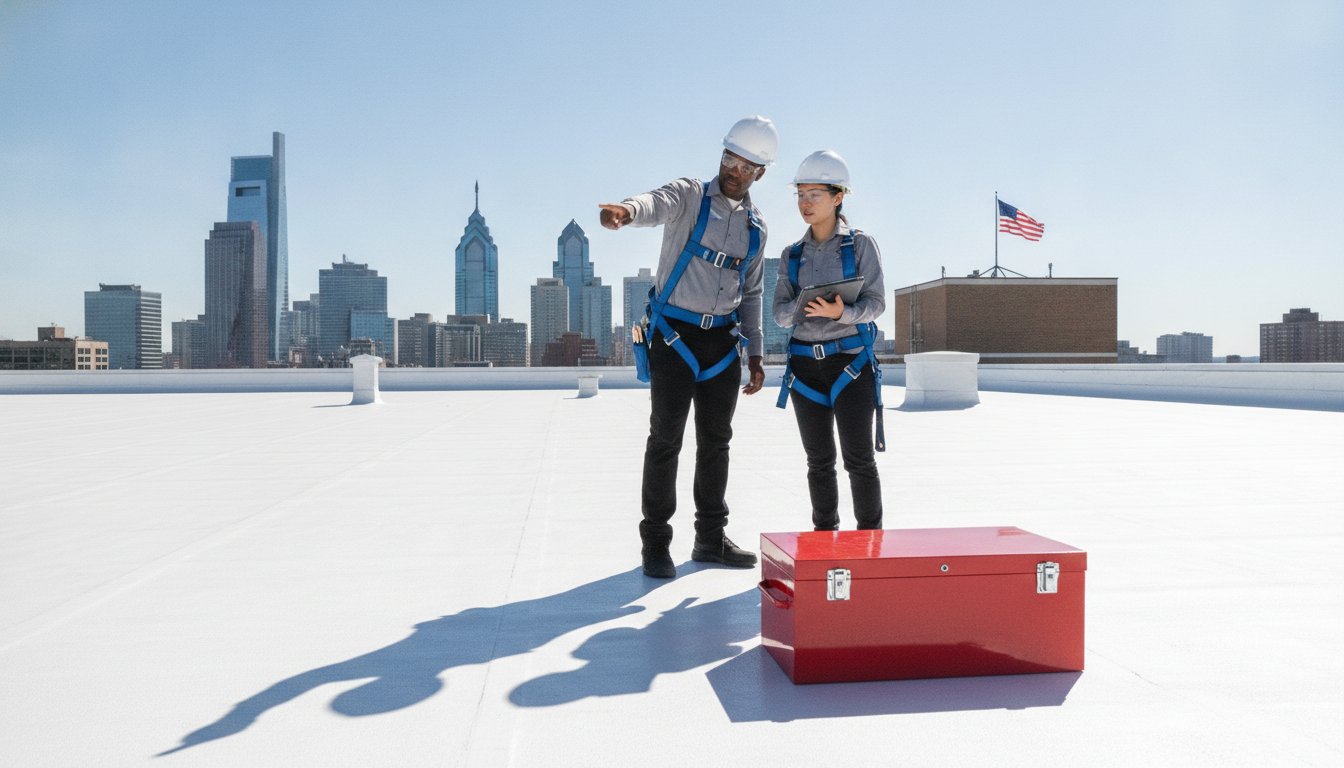
Philadelphia's climate is a relentless adversary for industrial roofing systems. A tactical walk-through is mandatory every six months to ensure asset survival. Effective commercial exterior maintenance Philadelphia requires a forensic approach to every square foot of the membrane. You cannot rely on a casual visual scan from the ground. This checklist provides a methodical framework for property managers to identify vulnerabilities before they escalate into structural breaches.
The Semi-Annual Inspection Framework
Spring inspections focus on winter-related degradation. The Delaware Valley's freeze-thaw cycles cause significant stress on roofing materials as ice expands in seams and drainage points. We clear all winter debris to ensure the drainage system meets the strict 2026 building code requirements for flow efficiency. Fall inspections are defensive. We prepare the membrane for sub-zero temperatures and the heavy dead load of winter snow. Thermal contraction can pull seams apart; we identify these tension points before the first freeze.
Your forensic walk-through must prioritize these critical areas:
- HVAC Curbs: Inspect seals and flashing for vibration-induced cracks or separation.
- Skylights: Check for frame integrity and UV degradation of the glazing.
- Parapet Walls: Verify that coping caps are secure and masonry joints are watertight.
- Membrane Seams: Use physical probes to test for delamination in TPO and EPDM systems.
Storm Readiness and Response
High-wind events in Philadelphia test the uplift resistance of your roofing system. Post-storm assessments must be immediate and documented. We look for perimeter flashing displacement and membrane "tenting" which indicates a failure of the underlying fasteners. Hail damage is a specific threat that requires technical expertise to detect. Small fractures in the membrane surface can lead to insulation saturation long before a ceiling leak appears. If your facility is located in the surrounding regions, utilize our specialized hail damage roof repair Reading PA protocols for tactical restoration.
Documentation is the backbone of your maintenance strategy. Every inspection, repair, and drainage clearance must be logged in an industrial-grade maintenance file. This log serves as forensic evidence for insurance adjusters and property buyers, proving the structural safety of the asset. Inconsistent records lead to claim denials and reduced property value. Secure your facility's future and schedule a forensic roof inspection to establish your 2026 maintenance baseline today.
Prestige Operations: Industrial-Strength Roofing Solutions
Prestige Operations is a strategic partner for high-stakes facility requirements. We don't offer generic maintenance. We provide industrial-strength reliability for commercial roofing systems. Our commercial exterior maintenance Philadelphia protocols are built on forensic analysis and logistical mastery. We treat your roof as a critical asset that requires precision management. Our teams are unfazed by large-scale complexity. We deliver results that protect your structural integrity and your bottom line.
We utilize specialized equipment to map membrane degradation with technical accuracy. Our forensic inspection capabilities include thermal moisture detection and physical seam testing. We identify delamination, fastener back-out, and substrate saturation before they become catastrophic. Our reporting is streamlined for property managers and liquidators. You'll receive clear, data-backed assessments of your roofing assets. No unnecessary narratives. Just the technical facts needed for decisive action.
Logistical Mastery in Facility Maintenance
Managing large-scale roofing footprints requires a specialized skill set. We handle complex requirements across diverse industrial sectors. The Prestige standard means boots-on-the-ground capability and fast-paced execution. We operate with methodical efficiency to ensure your operations remain uninterrupted. Our expertise extends to high-stakes property transitions. We have a proven track record of managing roofing assets during commercial property liquidation Philadelphia. We provide the documented structural integrity required for insurance compliance and asset valuation. We're the decisive partner you need for complex roofing management.
Secure Your Structural Integrity Today
Proactive asset protection is the only way to avoid the high cost of emergency failures. Secure your facility's future with our tactical maintenance protocols. We serve the entire region, including Philadelphia, Allentown, Reading, and Collegeville. Our teams are equipped for rapid deployment and forensic-level detail. We focus on the functional and logistical aspects of roofing management to extend your system's lifecycle. Don't let your building envelope become a liability. Request an industrial roofing maintenance estimate from a seasoned expert. Schedule a tactical roofing assessment to establish your asset protection baseline today.
Secure Your Structural Assets for 2026
Effective facility management requires a decisive shift from reactive leak-chasing to tactical asset protection. The roofing system is the anchor of your building envelope. Neglect leads to compromised structural integrity and massive financial liability. By implementing industrial-strength protocols and forensic inspections, you can extend your roof's lifecycle by over a decade. Adhering to the 2026 code updates ensures your facility remains a secure, high-value asset. Consistent commercial exterior maintenance Philadelphia is the only way to stabilize your operating budget against the Delaware Valley's brutal freeze-thaw cycles.
Prestige Operations brings tactical roofing expertise and industrial-strength reliability to every project. We serve Greater Philadelphia and the Lehigh Valley with a boots-on-the-ground demeanor that prioritizes your facility's safety. Don't wait for a structural breach to force your hand. Take control of your building's future today. Secure Your Roofing Assets with Prestige Operations and ensure your industrial facility is ready for the challenges of 2026. Your roof is your first line of defense; keep it impenetrable.
Frequently Asked Questions
How often should a commercial roof in Philadelphia be inspected?
Commercial roofs in the Philadelphia metropolitan area require professional inspections at least twice per year. Spring inspections identify damage from winter freeze-thaw cycles. Fall inspections prepare the membrane for heavy snow loads. Tactical asset management also dictates a forensic walk-through after high-wind events or hailstorms. These scheduled evaluations prevent minor vulnerabilities from escalating into catastrophic structural failures. Regular assessments are essential for maintaining industrial-strength reliability across the Delaware Valley.
What are the most common roofing failures in Philadelphia industrial buildings?
Philadelphia industrial facilities frequently experience seam delamination in TPO and EPDM systems due to extreme thermal expansion. Clogged drainage systems lead to ponding water, which adds excessive dead load to the structure. Urban heat island effects accelerate membrane oxidation and UV degradation. Punctures from HVAC maintenance or airborne debris also compromise the building envelope. Identifying these failures through forensic inspection is critical for property value retention and operational uptime.
Can preventative maintenance really extend a TPO roof’s lifespan?
Methodical preventative maintenance can extend a TPO roof's operational life by more than a decade. Consistent commercial exterior maintenance Philadelphia programs prevent subsurface moisture from saturating industrial insulation. Catching delaminated seams early stops water from reaching the roof deck. This proactive approach defers the massive capital expenditure of a total system replacement. It transforms the roof from an unpredictable liability into a stable, long-term asset for your facility.
Does commercial exterior maintenance include roof coating services?
Roof coating is a primary component of industrial-strength maintenance protocols. These reflective coatings protect the underlying membrane from UV radiation and urban pollutants common in the Philadelphia metro area. Applying a technical coating system can restore the integrity of an aging roof without the disruption of a full tear-off. This service is a strategic tool for property managers seeking to improve thermal efficiency and satisfy new 2021 ICC energy standards.
What is a forensic roofing inspection for commercial properties?
A forensic roofing inspection is a technical, data-driven evaluation of the entire roofing system. Unlike a casual visual scan, it utilizes specialized equipment like thermal imaging cameras to detect trapped moisture. Inspectors use physical probes to test seam strength and analyze core samples of the substrate. This process provides a definitive record of the roof's structural condition. It is an essential requirement for property liquidation assessments and high-stakes insurance renewals.
How does Philadelphia weather specifically impact EPDM roofing systems?
Philadelphia’s extreme temperature swings cause significant thermal shock in EPDM systems. The black membrane absorbs high levels of heat, leading to membrane shrinkage and tension at the perimeter. This stress often results in flashing separation and seam failure. Additionally, the region’s freeze-thaw cycles can expand small cracks in the rubber, allowing water to penetrate the building envelope. Tactical maintenance focuses on reinforcing these high-stress areas to prevent structural compromise.
Is roof maintenance required for commercial insurance compliance in PA?
Most commercial property insurers in Pennsylvania require documented maintenance logs to maintain full coverage. Insurers often reduce claim payouts or switch to actual cash value coverage for roofs older than 15 years that lack maintenance records. Proving that you perform regular commercial exterior maintenance Philadelphia evaluations is vital for claim approval. Documented structural safety reduces the insurer's risk and protects your facility against liability during high-wind or hail events.
How do I budget for annual commercial roofing maintenance in 2026?
Effective budgeting for 2026 focuses on scheduled inspections rather than emergency response. Facility managers should allocate funds for semi-annual forensic walk-throughs and minor seam repairs. This predictable expenditure prevents the high costs associated with emergency shutdowns or unplanned capital replacements. A tactical budget also accounts for drainage clearance and debris removal. Investing in consistent maintenance allows for long-term asset protection and stable operating expenses across your industrial property portfolio.