A clogged drainage system isn't just a maintenance oversight; it's a direct threat to your building's structural integrity. When standing water accumulates on a flat roof, you aren't just dealing with a mess. You're risking a catastrophic failure of your primary roofing asset. Professional commercial gutter cleaning Philadelphia operations are the first line of defense against premature membrane degradation and voided warranties. Neglect is not an option for high-stakes facilities.
You understand that managing large-scale infrastructure requires more than reactive fixes. It demands a tactical approach to debris management that keeps your drainage at zero-failure capacity during intense storms. This article provides a blueprint for securing your roof's lifecycle through industrial-strength maintenance protocols. We'll cover the impact of the 2021 International Building Code updates effective in July 2026, the necessity of OSHA-compliant fall protection for roof access, and how authoritative reporting eliminates the logistical headaches of roof asset preservation.
Key Takeaways
- Identify the direct link between drainage efficiency and the long-term integrity of your commercial roofing membrane.
- Secure your facility with commercial gutter cleaning Philadelphia protocols that meet industrial forensic standards for asset protection.
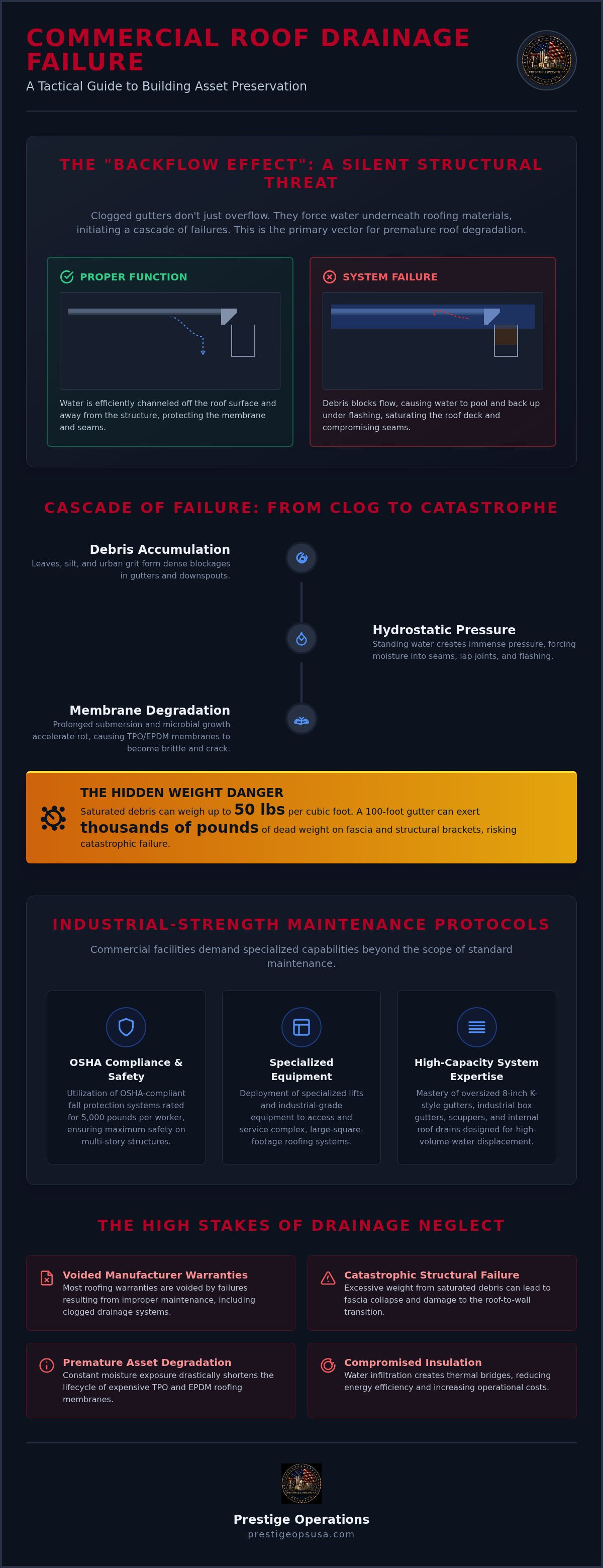
- Recognize the "backflow effect" where gutter blockages force water under roof flashings, compromising critical structural seams.
- Deploy a tactical 2026 maintenance schedule tailored to Philadelphia's specific urban foliage and projected rainfall intensity.
- Transition from basic surface maintenance to a decisive roofing asset preservation strategy that protects your building's structural warranty.
Tactical Gutter Cleaning: The Foundation of Commercial Roof Integrity
Commercial gutter cleaning is not a janitorial task. It's a tactical roofing maintenance protocol. In the Philadelphia region, industrial facilities face high-volume precipitation and extreme seasonal shifts. If your drainage fails, your entire roofing system is at risk. Effective management of every component of a water discharge system is the primary defense for the building envelope. We treat gutters as critical roofing assets, not peripheral hardware. Neglect leads to standing water. Standing water leads to membrane failure. Comprehensive commercial gutter cleaning Philadelphia operations ensure that water moves off the roof surface with zero resistance.
Drainage Systems as Roofing Components
Scuppers, downspouts, and gutters are integral to the roofing system. They aren't secondary features; they're the arteries of the roof. On flat or low-slope roofs, poor drainage significantly increases hydrostatic pressure. This pressure forces moisture into seams, lap joints, and flashing transitions. When water lingers, it accelerates the degradation of roofing adhesives and creates thermal bridges that compromise insulation. 'Drainage-link' is the critical connection between gutter flow and roof health. Without this link, even the most advanced TPO or EPDM membrane will degrade well before its projected lifecycle ends. Maintaining this flow is essential for protecting the structural integrity of the roof deck.
Industrial Scope and Capability
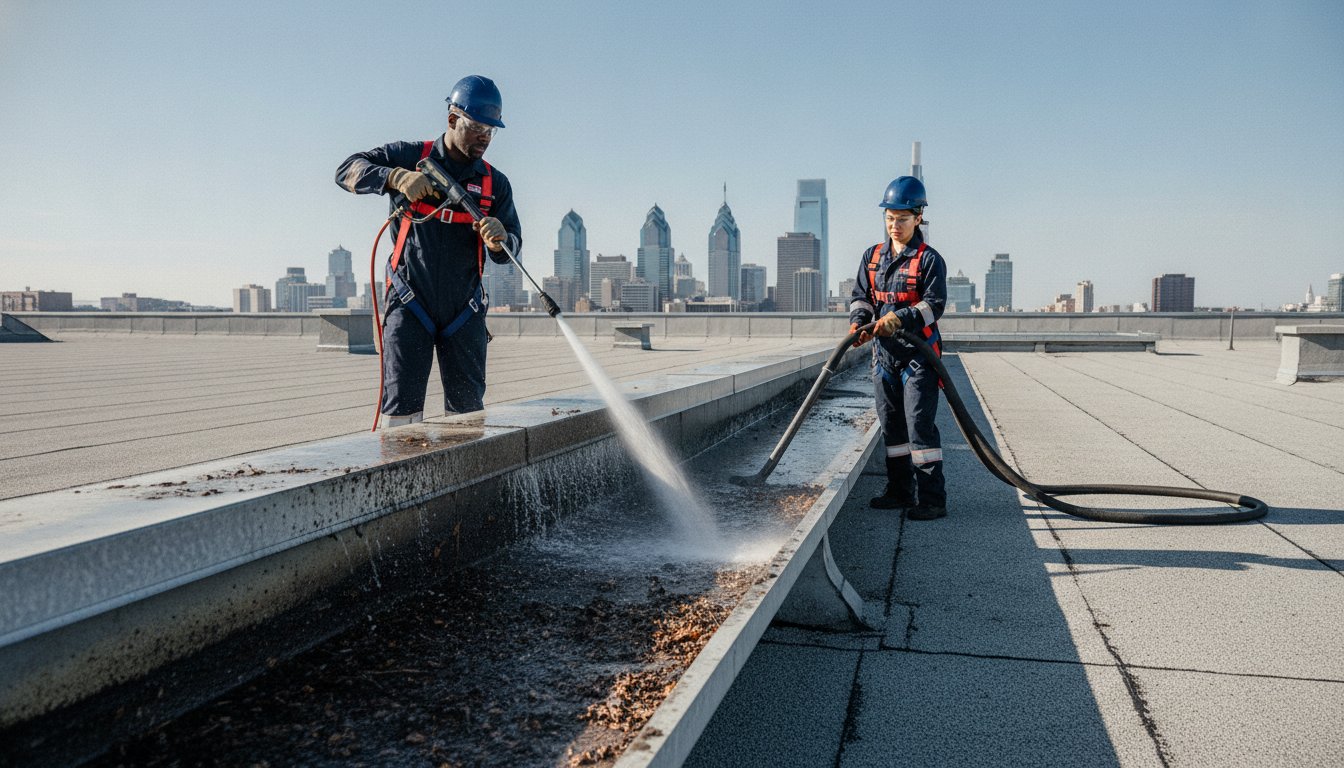
Large-square-footage facilities present unique logistical challenges that residential contractors cannot handle. Standard equipment fails at scale. Accessing multi-story commercial roofs requires specialized lifts and OSHA-compliant fall protection systems rated for 5,000 pounds per worker. Industrial-grade debris removal is mandatory for high-capacity systems designed to move thousands of gallons of water per hour. We manage the logistics of scale with "boots-on-the-ground" precision. Our team operates with an unfazed focus on performance in high-stakes environments.
Effective commercial gutter cleaning Philadelphia services must account for:
- Oversized 8-inch K-style gutters and industrial box gutters.
- High-volume scupper boxes and internal roof drains.
- Complex multi-level roof transitions.
- Heavy urban debris and industrial particulate accumulation.
Precision execution prevents the backflow issues that void roofing warranties. We provide the technical expertise needed to handle complex infrastructure with industrial-strength reliability. Every service is a decisive step toward long-term asset preservation.
Mechanics of Failure: How Clogged Gutters Compromise Commercial Roofing
Clogged gutters aren't just a flow issue. They're a structural liability. In Philadelphia, heavy rain can overwhelm a compromised drainage system in minutes. When gutters reach capacity, water doesn't just spill over the front edge. It backs up. This 'backflow' effect forces water under roof flashings and drip edges. Once moisture penetrates these transitions, it attacks the roof substrate and internal decking. This is why commercial gutter cleaning Philadelphia is a non-negotiable asset preservation tactic for industrial facilities.
Membrane Degradation and Seam Failure
Prolonged moisture exposure is the primary enemy of EPDM and TPO roofing systems. These membranes are designed for shedding water, not for constant submersion. Standing water creates hydrostatic pressure that weakens seams and chemical adhesives. Organic debris trapped at the roof edge fosters microbial growth. This biological rot accelerates the degradation of the membrane surface, leading to brittleness and cracking. According to IBHS commercial roof drainage guidelines, effective water management is essential to prevent these premature failures. You should monitor for 'alligatoring' or soft spots near the perimeter as early indicators of drainage-related deterioration.
Structural Load and Safety Risks
Industrial gutters are high-capacity components. When they fill with wet leaves, silt, and urban grit, the weight becomes immense. Saturated organic matter can weigh up to 50 pounds per cubic foot. A hundred-foot run of clogged industrial trough puts thousands of pounds of dead weight on fascia boards and structural brackets. This load threatens the integrity of roof-to-wall transitions and risks sudden gutter detachment. A falling gutter on a commercial site represents a massive liability and potential for significant structural damage. Identifying these risks early through tactical roof maintenance prevents catastrophic failure.
Metal roofing systems face a specific chemical threat. Organic rot in gutters creates an acidic environment. This accelerates the corrosion of galvanized steel or aluminum panels. Once the protective coating fails, rust penetrates the structural deck, compromising the entire building envelope. We see this frequently in facilities that skip seasonal cleanings. The cost of a cleaning is a fraction of the cost of a structural metal deck replacement. Keeping water moving is the only way to ensure your roof reaches its full service life.
Forensic Cleaning vs. Surface Maintenance: The Industrial Standard
Surface maintenance is a liability. Forensic cleaning is a strategic asset. Most providers offer 'blow-and-go' services that clear visible debris but ignore the underlying mechanics of the drainage system. This approach fails to protect the building envelope. The industrial standard for commercial gutter cleaning Philadelphia demands a comprehensive forensic evaluation. We don't just clear troughs; we verify the structural integrity of the entire discharge path. If water isn't moving at peak velocity, the service hasn't been performed correctly.
The Forensic Inspection Protocol
Rapid water evacuation depends on precise pitch and alignment. During the cleaning process, we assess every linear foot for sagging or structural fatigue. We inspect joints, hangers, and fasteners to ensure they can withstand the 25 psf snow load standard for Philadelphia roofs. This is also the optimal time to identify roof-specific issues. We look for excessive granulate loss in asphalt systems or membrane shrinkage at the perimeter. Identifying these problems during a drainage service prevents them from becoming emergency repairs. Our team treats the gutter as a diagnostic tool for the entire roofing system.
Logistical Mastery in Execution
Operating on high-stakes commercial sites requires absolute precision. We maintain strict OSHA compliance for all roof access, including verified fall protection and anchor points rated for 5,000 pounds. As a leading commercial roofing contractor Philadelphia, we understand that your facility must remain operational. Our team coordinates with site management to minimize downtime. We use industrial-grade equipment and high-pressure flow testing to clear downspouts and underground leads. This ensures that water doesn't just leave the gutter; it leaves the property.
Clear-flow testing is mandatory. If a downspout is blocked internally, the gutter will overflow regardless of how clean the trough appears. We provide transparent, authoritative reporting for every service. This documentation is critical for maintaining manufacturer roof warranties. It proves that the asset has been managed according to professional standards. We operate with the speed and thoroughness required for large-scale property management. Every action is documented to provide a clear audit trail of asset preservation. This level of detail is what separates industrial-strength maintenance from a basic cleaning service.
Effective commercial gutter cleaning Philadelphia requires more than a ladder and a bucket. It requires a deep understanding of roofing physics and the logistical capability to execute on complex structures. We deliver results that secure your structural integrity and extend your roof's lifecycle. We don't just manage debris; we manage risk.
2026 Maintenance Protocols: Scheduling for Philadelphia Weather Patterns
Philadelphia weather patterns are aggressive. Your drainage schedule must be more aggressive. A passive maintenance plan is a precursor to roof failure. Effective commercial gutter cleaning Philadelphia operations align with the local climate to ensure zero-failure capacity. We don't guess at timing; we follow a tactical calendar based on regional foliage cycles and rainfall projections. In 2026, the intensity of Delaware Valley storms requires a decisive approach to debris management. If your gutters are at 50% capacity when a high-volume rain event hits, your roofing membrane is already under threat.
The Philadelphia Climate Factor
Managing heavy rainfall events is a logistical necessity for Philadelphia properties. The region's freeze-thaw cycles present a specific danger to roofing systems. When moisture remains trapped in gutters during a freeze, it expands against the roof's edge and drip edge. This pressure can compromise the seal of your membrane. As a seasoned Collegeville roofing contractor, we've seen how neglected drainage leads to ice damming on flat roofs. Ice dams don't just block flow; they force meltwater under the roofing material during the thaw phase. This is a primary cause of interior leaks and structural rot in industrial facilities.
Predictive Maintenance Scheduling
We operate with a three-step tactical roadmap to ensure your roof remains protected year-round. This isn't a suggestion; it's an industrial standard for asset preservation.
- Step 1: Forensic Spring Assessment. Performed immediately after the spring bloom. This phase removes pollen, seeds, and early-season debris that can clog scuppers before summer thunderstorms.
- Step 2: Mid-Summer Flow Verification. A mid-season check to ensure urban grit and industrial particulate haven't compromised the drainage path before the heavy rains of late summer.
- Step 3: Tactical Autumn Cleanup. Executed after the final foliage drop. This is the most critical phase for preventing winter ice dams and ensuring the system can handle the 25 psf snow load standard for the Philadelphia area.
Urban debris is a constant factor. In high-density areas, industrial particulate and roofing granules accumulate faster than in suburban environments. This silt settles at the bottom of gutters, creating a heavy sludge that slows water velocity. Slow water is dangerous water. It allows more debris to settle and increases the weight on your structural hangers. You can schedule a tactical roof inspection to verify your current drainage capacity and adjust your 2026 calendar accordingly. We prioritize efficiency and scale to keep your facility protected against the most volatile Philadelphia weather patterns.
Zero-failure drainage is the objective. By following a predictive schedule, you transition from reactive repairs to strategic asset management. We provide the "boots-on-the-ground" expertise to execute this schedule with precision. Your roof's lifecycle depends on the speed at which water leaves the surface. Don't let a seasonal foliage drop become a structural crisis.
Prestige Operations: Logistical Mastery in Roof Drainage Solutions
Prestige Operations operates with a "boots-on-the-ground" mentality. We understand that your commercial roof is a high-value asset. It requires technical management, not just routine care. Our team specializes in the logistical mastery of drainage systems for large-scale facilities. We provide the decisive partnership needed for complex roofing requirements. Every commercial gutter cleaning Philadelphia project we undertake is executed with industrial-strength reliability. We focus on results that secure your building envelope against the most severe environmental threats. Our team is unfazed by the scale of industrial infrastructure; we prioritize competence and precision in every action.
Industrial-Strength Reliability
Precision is our baseline. In high-stakes commercial environments, there's no room for error. We leverage deep expertise in Philadelphia property solutions to manage extensive roofing portfolios with methodical efficiency. Our commitment to technical excellence ensures that your drainage system functions as a seamless extension of your roofing membrane. This is particularly critical during asset transitions. If you're managing a commercial property liquidation Philadelphia, a comprehensive roofing asset checklist is essential for maintaining value. We provide the forensic documentation needed to prove your drainage systems are clear and your warranties are intact. We handle the logistical heavy lifting so you can focus on your core operations.
Secure Your Roofing Asset
Decisive action today prevents catastrophic roofing failure tomorrow. Neglecting your drainage path is a gamble with your structural integrity. The Prestige advantage lies in our authoritative approach to asset protection. We don't offer generic fixes. We deliver strategic solutions tailored to the specific demands of Philadelphia industrial roofing. Your facility deserves a partner that prioritizes competence and comprehensive service over casual interaction. We operate with a serious, disciplined demeanor that reflects the high-stakes nature of physical infrastructure management.
Secure your infrastructure now. A tactical drainage assessment identifies vulnerabilities before they escalate into membrane breaches or structural rot. You can initiate a tactical roofing drainage assessment to establish a baseline for your 2026 maintenance cycle. We move with the steady progress of a large-scale project, ensuring your roof reaches its maximum lifecycle. Your drainage system is the first line of defense. Ensure it's managed by a leader in the field who understands the technical nuances of roofing physics. We are the decisive partner for your most complex exterior maintenance requirements.
Tactical Asset Protection for 2026 and Beyond
Tactical drainage management is the cornerstone of roofing asset preservation. You've seen how clogged systems lead to membrane failure, structural load risks, and voided warranties. A reactive approach is no longer viable in the 2026 Philadelphia climate. Professional commercial gutter cleaning Philadelphia operations are the first line of defense for any industrial roof. Transitioning to a forensic cleaning standard ensures that your scuppers and downspouts function as high-capacity roofing components. This is about securing the building envelope against hydrostatic pressure and seasonal freeze-thaw cycles.
Prestige Operations delivers industrial-strength reliability for Philadelphia facilities through specialized expertise in commercial roofing systems. We provide the OSHA-compliant logistical mastery required to manage complex property portfolios with precision. Our "boots-on-the-ground" approach eliminates the headaches of large-scale maintenance while extending your roof's lifecycle. Don't wait for a structural breach to address your drainage flow. It's time to prioritize competence and comprehensive service.
Secure your roofing asset with a tactical assessment from Prestige Operations. Establishing a professional maintenance protocol today protects your infrastructure for years to come.
Frequently Asked Questions
Why is commercial gutter cleaning critical for roof warranty compliance in Philadelphia?
Most commercial roofing manufacturers mandate documented maintenance to keep structural warranties active. If drainage blockages cause standing water or membrane saturation, manufacturers often deny claims for leaks or premature failure. In Pennsylvania, documenting your commercial gutter cleaning Philadelphia service provides the necessary audit trail to prove professional care. Regular cleaning prevents the backflow effect that forces water into structural seams, ensuring your warranty remains a valid financial safeguard for your facility.
How often should Philadelphia industrial facilities schedule gutter maintenance?
Industrial facilities in the Philadelphia area should schedule maintenance at least twice annually. The primary cleaning phases occur post-spring bloom to clear seeds and pollen, and late autumn after the final foliage drop. Facilities near heavy urban vegetation or industrial zones with high particulate output may require quarterly assessments. This tactical schedule prevents the accumulation of heavy sludge that slows water velocity and threatens the structural integrity of the roof deck during high-volume storms.
Can clogged gutters cause structural damage to a commercial flat roof?
Clogged gutters create significant structural risks for flat roofs. When water cannot exit through scuppers or downspouts, it pools on the membrane, increasing hydrostatic pressure on seams and adhesives. Saturated organic debris in large industrial troughs can weigh up to 50 pounds per cubic foot. This dead weight puts immense stress on fascia boards and structural brackets, potentially leading to gutter detachment or permanent damage to the critical roof-to-wall transitions.
What are the signs that my commercial drainage system is failing?
Identifying drainage failure early is essential for roof asset protection. Common indicators include standing water on the roof surface long after rain has stopped, visible staining on fascia boards, and overflowing scupper boxes. You might also notice sagging in industrial troughs or moisture infiltration near building perimeters. If you see roofing granules accumulating in large quantities within the gutters, it indicates both a drainage blockage and advanced degradation of your asphalt-based roofing system.
What safety protocols are required for commercial gutter cleaning in Pennsylvania?
OSHA regulations mandate strict fall protection for any work performed at heights. For commercial gutter cleaning Philadelphia, workers must utilize personal fall arrest systems if they're 4 feet or more above a lower level in general industry settings. Anchor points must be rated to support a minimum of 5,000 pounds per worker. Professional teams follow high-access protocols involving specialized lifts and ladders that meet current industrial safety standards to mitigate property owner liability.
How does professional gutter cleaning extend the life of a TPO or EPDM roof?
Professional cleaning prevents the pond effect that accelerates the breakdown of synthetic membranes. While TPO and EPDM are durable, constant submersion weakens the chemical bonds at lap joints and perimeter flashings. Removing organic rot prevents microbial growth that can eat into the membrane surface over time. By keeping water moving, you ensure the roof stays dry, preventing the brittleness and seam failure that typically shorten the lifecycle of these industrial roofing systems.
What is the difference between residential and industrial gutter maintenance?
Industrial maintenance involves significantly higher stakes and technical complexity than residential services. Commercial systems use oversized 8-inch K-style or box gutters, high-volume scuppers, and internal roof drains that require industrial-grade flow testing. The logistical mastery required to access multi-story roofs safely and the need for authoritative documentation for warranty compliance are unique to the commercial sector. Residential services rarely account for the hydrostatic pressure issues or snow load calculations critical to industrial roof health.
How do Philadelphia winter conditions affect commercial roof drainage?
Philadelphia's freeze-thaw cycles are particularly hazardous for commercial roof drainage. Blocked gutters trap moisture that expands as it turns to ice, potentially prying the drip edge or membrane away from the roof substrate. This creates ice dams that force meltwater under the roofing material during the thaw phase. Maintaining clear drainage paths is vital to manage the 25 psf ground snow load and prevent the structural rot associated with winter water infiltration on flat roofs.