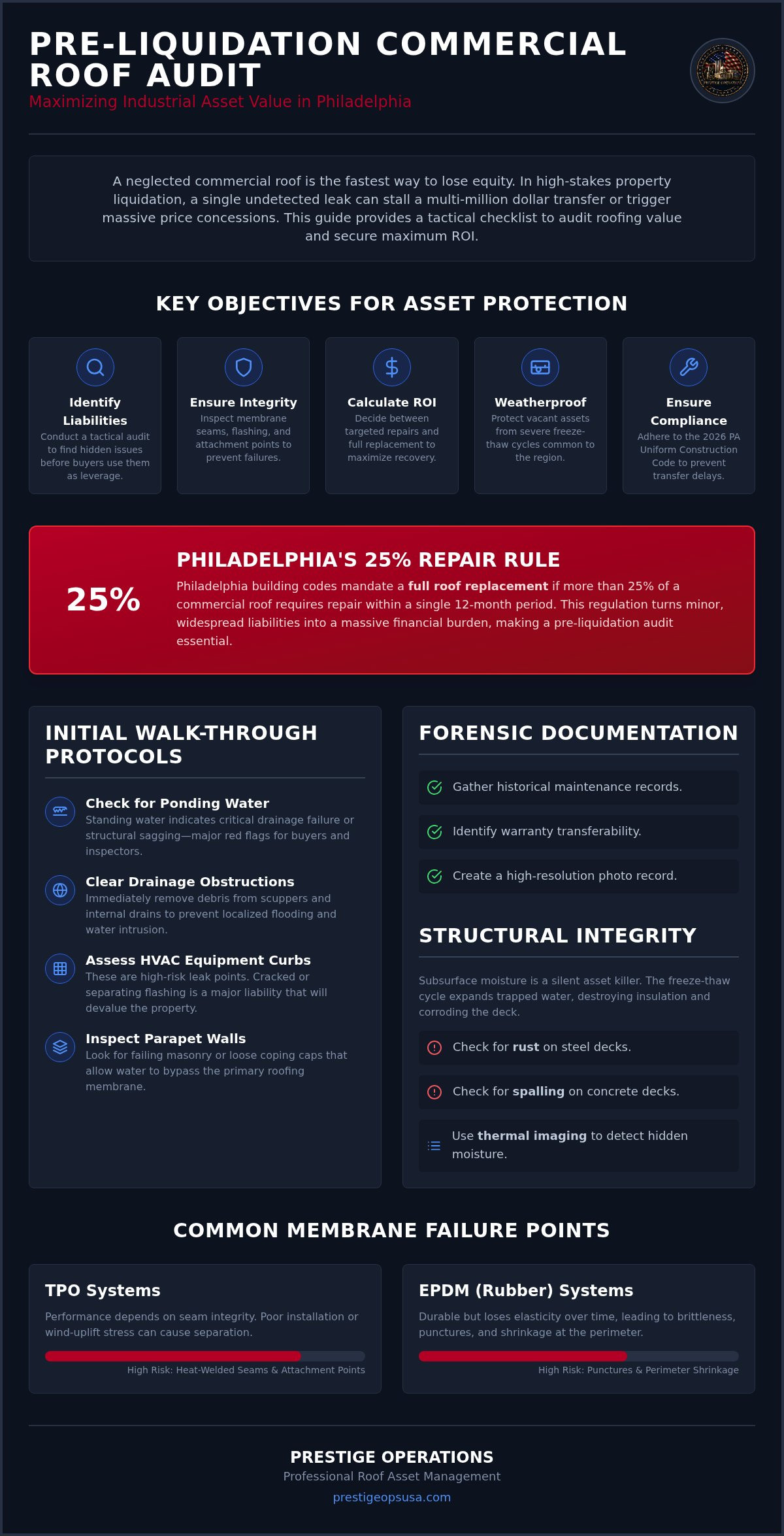
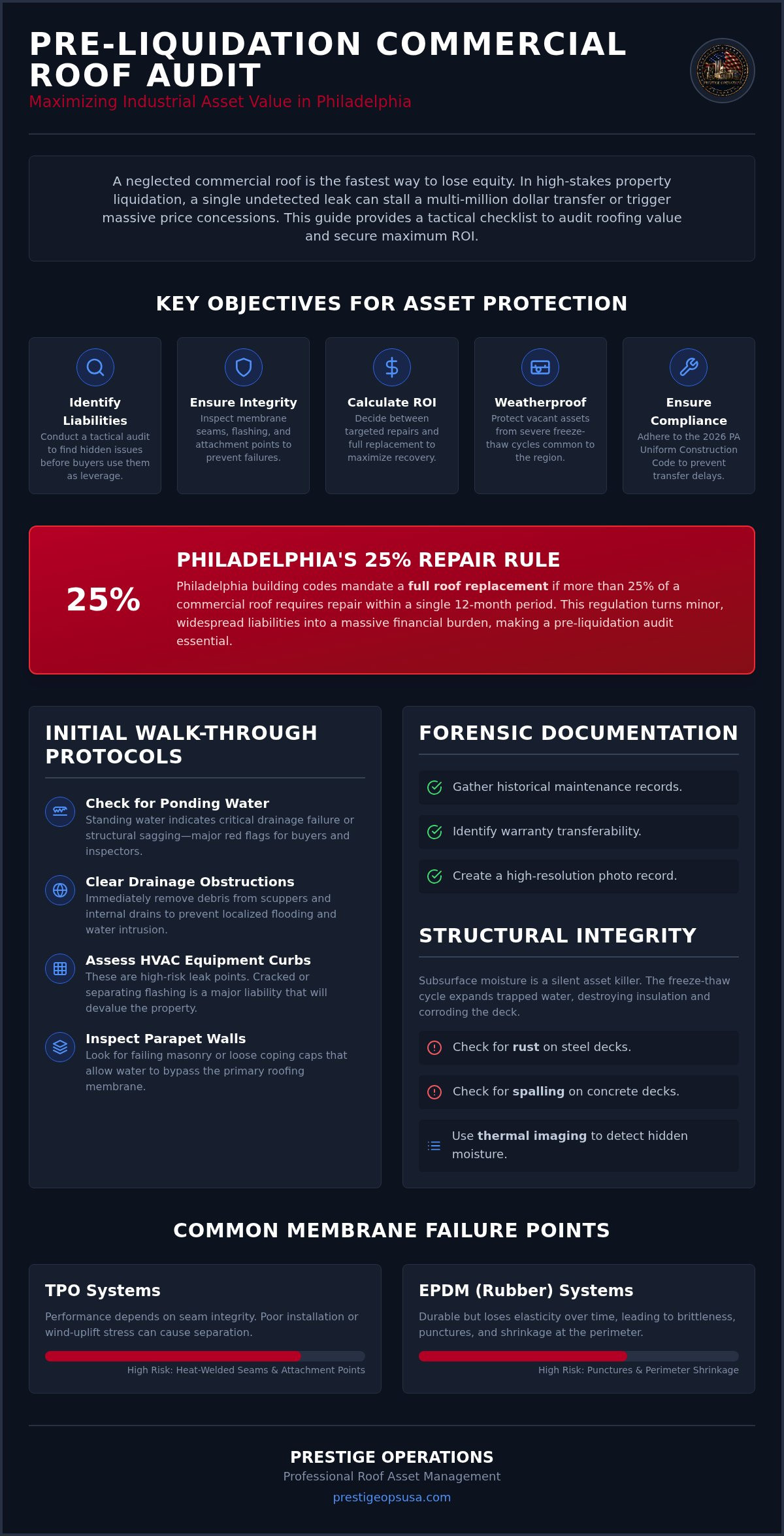
A neglected commercial roof is the fastest way to hemorrhage equity during a liquidation event. In the high-stakes environment of commercial property liquidation Philadelphia, a single undetected leak can stall a multi-million dollar transfer or trigger a massive price concession. You understand that roofing integrity is the frontline of asset protection. If the roof fails, the entire facility's value is compromised. There's no room for error when industrial assets are on the line.
This article provides a tactical checklist to audit roofing value and secure the maximum ROI on your liquidated asset. We focus on the industrial realities of 2026, including the Pennsylvania Uniform Construction Code updates and Philadelphia's specific 25% repair rule. You'll learn how to maintain TPO, EPDM, and metal systems to prevent emergency liabilities during the sale process. We break down the logistical steps to ensure your roofing assets meet transfer requirements and survive the interval of vacancy. This is a boots-on-the-ground guide for decisive asset management and logistical mastery.
Key Takeaways
- Conduct a tactical roofing audit to identify hidden liabilities before buyers use them as leverage to chip away at your asking price.
- Execute a precise inspection of membrane seams, attachment points, and flashing to maintain structural integrity throughout the sale process.
- Calculate the ROI of targeted repairs versus full system replacement to maximize your recovery during commercial property liquidation Philadelphia.
- Deploy weatherproofing protocols to protect vacant industrial assets from the severe freeze-thaw cycles common in the Philadelphia region.
- Ensure all roofing work adheres to the 2026 Pennsylvania Uniform Construction Code to prevent compliance delays during the property transfer.
Tactical Roofing Audit: Assessing Asset Value Before Liquidation
Roofing integrity is the primary driver of facility value. It's the first line of defense for any industrial structure. During the liquidation process, buyers scrutinize the roof to find leverage. A pre-liquidation audit establishes a position of strength. It prevents "price chipping" where buyers demand massive discounts for perceived roofing failures. In the context of commercial property liquidation Philadelphia, a clean bill of health is a financial tool. You can't afford to let a buyer define the condition of your assets. You must define it first with a professional audit.
Philadelphia's climate is aggressive on industrial membranes. High humidity in the summer and severe freeze-thaw cycles in the winter accelerate material degradation. TPO systems are common in the region, but their performance depends on seam integrity. EPDM, or rubber roofing, is durable but prone to shrinkage at the perimeter. Knowing the lifecycle of these systems allows you to set realistic expectations for the asset's remaining utility. An 80-mil TPO membrane has a different value profile than a 45-mil system nearing the end of its service life. You need to know exactly what you're selling before the first bid is placed.
Forensic Roof Documentation
Professional documentation is non-negotiable. It transforms a physical structure into a verifiable asset. Gather all historical maintenance records for the liquidating entity. These logs prove the roofing system was managed with industrial-strength reliability. You must also identify warranty transferability. A manufacturer's warranty that follows the property title adds significant marketability and reduces buyer risk. Create a high-resolution photographic record of every roof section. This baseline prevents buyers from claiming damage occurred after their initial inspection. It locks in the condition of the asset at the time of the listing.
Initial Walk-Through Protocols
Speed and precision are required for the initial assessment. Look for signs of deferred maintenance that signal neglect to a potential purchaser. Use these protocols to secure the site:
- Check for ponding water: Standing water indicates drainage failure or structural sagging. Both are red flags for inspectors.
- Clear drainage obstructions: Remove debris from scuppers and internal drains immediately to prevent localized flooding.
- Assess HVAC equipment curbs: These are high-risk leak points. If the flashing around these units is cracked or pulling away, it's a liability that will tank a sale.
- Inspect parapet walls: Look for failing masonry or loose coping caps that allow water to bypass the roofing membrane.
By identifying these issues early, you retain control over the narrative of the sale. You decide which repairs are worth the investment to protect the final recovery price.
Structural Integrity Checklist: Identifying Roofing Liabilities
Identifying structural liabilities is the difference between a successful close and a failed asset recovery. During commercial property liquidation Philadelphia, buyers perform forensic inspections to find leverage. They'll hunt for membrane failures and deck rot to slash their offers. You've got to preempt this by conducting a technical structural review. Precision is your best defense against price chipping. Liabilities are often hidden in the details of the assembly, so a surface-level glance isn't enough.
Philadelphia building codes mandate a full replacement if more than 25 percent of a commercial roof requires repair within a 12-month period. This regulation makes small liabilities potentially massive financial burdens. You must assess the integrity of the roof deck and structural supports immediately. Check for rust on steel decks or spalling on concrete decks. These issues indicate long-term moisture infiltration that compromises the building's shell. Thermal imaging is the industry standard for detecting this subsurface moisture. In the Philadelphia climate, the freeze-thaw cycle expands trapped water, which destroys insulation and corrodes the deck from the top down.
Membrane and Surface Analysis
Specific membrane types require specialized assessment protocols. For EPDM systems, check for punctures and excessive brittleness. These rubber membranes lose elasticity over time and are prone to perimeter shrinkage. TPO systems require a tactical inspection of all heat-welded seams and attachment points. Look for heat-weld failures where the membrane has separated due to poor installation or wind-uplift stress. If the property has a gravel-surfaced built-up roof, evaluate the surface for bare spots and blistering. Blistering indicates trapped moisture between the plies. These defects are high-priority items that must be documented to preserve the asset's market value.
Drainage and Perimeter Security
Water must leave the roof immediately to prevent structural strain. Test all scuppers, gutters, and downspouts for flow efficiency. Philadelphia storms can overwhelm compromised drainage systems, leading to catastrophic interior damage during the liquidation phase. Inspect edge metal and gravel stops for signs of corrosion or detachment. Loose metal allows wind to get under the membrane, which can lead to a total system failure in a high-wind event. Ensure all roof hatches and access points are secured to prevent unauthorized entry while the building is vacant. For professional oversight of these industrial requirements, consider expert roofing asset management to ensure every liability is documented and addressed.
Maintenance vs. Replacement: Strategic Decisions for Property Sales
Decisions in a liquidation environment are binary. You either invest to preserve the asset's value or you accept a lower recovery price. In the context of commercial property liquidation Philadelphia, the roofing system is the single most scrutinized component of the building shell. Buyers look for any excuse to devalue the property. A strategic decision between targeted maintenance and a full system replacement can shift the leverage back to the seller. You must determine if a capital expenditure now will yield a high enough ROI at the auction block.
Roof coatings are a tactical solution for membranes that are structurally sound but nearing the end of their service life. A high-solids silicone or acrylic coating can extend the life of an EPDM or TPO system by a decade at a fraction of the cost of a tear-off. However, Philadelphia's building codes are strict. If more than 25 percent of the roof area requires repair within a 12-month period, a full replacement is often mandated. Ignoring this rule during the liquidation phase is a mistake. A certified commercial roofing inspection Philadelphia removes this ambiguity. It provides a documented baseline that proves the system's viability to skeptical buyers.
Cost-Benefit Analysis of Roof Repairs
Identify "must-fix" items immediately. Leaks near electrical mains or failing flashing around heavy HVAC equipment are non-negotiable repairs. These defects cause rapid interior damage that tanks property value. Targeted repairs to seams and penetrations are low-cost moves that prevent catastrophic failures during the sales cycle. You should leverage professional commercial roofing estimates as a tool in price negotiations. Presenting a buyer with a vetted cost for future work prevents them from overestimating the liability and "price chipping" your final recovery amount.
Compliance and Certification
Compliance is a core value driver in 2026. Pennsylvania has updated the Uniform Construction Code to align with the 2021 ICC series. Your roofing system must meet current fire and wind-uplift standards to be considered a "turn-key" asset. A professional roof condition report should be a standard part of your disclosure package. This report must address:
- Wind-uplift ratings: Ensuring edge metal and attachment patterns meet updated 2026 safety protocols.
- Fire resistance: Verifying the assembly meets Class A or B fire ratings required for industrial zones.
- Code violations: Clearing any outstanding Department of Licenses and Inspections (L&I) citations before the transfer.
Clearing these hurdles before the property hits the market demonstrates logistical mastery. It signals to buyers that the asset is ready for immediate operation without the threat of municipal intervention or insurance denials.
Weatherproofing Protocols for Vacant Liquidated Assets
Vacancy is a catalyst for rapid asset degradation. When a building sits idle during commercial property liquidation Philadelphia, the roof becomes its most vulnerable point. Minor leaks that would be caught by occupants in an active facility can cause catastrophic structural damage in a vacant one. You must implement a rapid-response maintenance plan to protect the building shell. This isn't just about preservation; it's about insurance compliance. Most commercial insurers in Philadelphia reduce coverage or switch to actual cash value for roofs over 15 years old. Neglecting maintenance on a vacant property provides grounds for claim denial during the most sensitive phase of the sale.
Philadelphia's winter climate creates a cycle of destruction for industrial roofing. The freeze-thaw effect forces water into microscopic membrane cracks and seams. As the water freezes, it expands and rips the material apart. You need a disciplined monitoring schedule during the listing period. Monthly inspections ensure that small issues don't escalate into emergency liabilities that stall your sale. Securing roof-mounted assets is equally critical. Copper flashing and HVAC components are prime targets for theft in vacant properties. You must treat the roof as a high-security zone to maintain the asset's liquidation value.
Seasonal Protection Measures
Proactive exterior maintenance is the only way to survive a Philadelphia winter. Clear all debris from drainage systems before the first frost. Clogged scuppers lead to massive weight loads from standing water and ice. You should apply temporary patches to any identified weak spots in the TPO or EPDM membrane immediately. Professional commercial gutter cleaning is a mandatory step to prevent ice damming. When gutters fail, water backs up under the roof edge and into the building's fascia. This causes rot that ruins the structural integrity of the perimeter and creates an expensive repair for the next owner.
Facility Security and Access Control
The roof is a common entry point for unauthorized individuals. You must reinforce all roof hatches and skylights with industrial-grade locking mechanisms. Don't leave ladders or equipment that provides easy access to the roof deck. Beyond theft, you must account for wind-uplift risks. High-wind events in the Delaware Valley can turn loose roofing materials into projectiles. Remove any abandoned equipment, loose gravel, or unsecured metal scraps from the roof surface. Coordinate with your exterior maintenance team to conduct regular perimeter checks. They should look for signs of tampering or wind damage at the roof edge. For decisive management of your industrial property assets, secure your facility with professional roofing maintenance services today.
Prestige Operations: Professional Roof Asset Management
Prestige Operations serves as the decisive partner for commercial property liquidation Philadelphia. We don't just inspect roofs; we manage industrial assets to ensure maximum recovery. Our approach is rooted in logistical mastery and a deep understanding of the high-stakes liquidation environment. We recognize that for receivers and owners, the roof is a critical variable in the valuation equation. Our team operates with precision to remove that uncertainty. We provide the technical clarity required to defend an asking price or secure a rapid transfer.
We specialize in asset recovery solutions that go beyond surface-level observations. Our comprehensive roofing audits are tailored specifically for the liquidation phase. We identify the exact state of your TPO, EPDM, or metal roofing systems. This allows stakeholders to make informed, results-driven decisions about maintenance versus replacement. We act as your boots-on-the-ground representative, handling the complexities of physical infrastructure so you can focus on the broader financial objectives of the liquidation.
Industrial Strength Reliability
Our capability extends across Pennsylvania, handling large-scale roofing systems with methodical efficiency. We maintain a high level of logistical mastery, ensuring that even the most complex industrial portfolios are audited and secured on tight timelines. Our focus is on precision execution. We don't guess at the condition of a structural deck or the integrity of a heat-welded seam. We verify it. This disciplined approach has built our proven track record in industrial roof asset management. We understand the specific stresses of the regional climate and the rigorous demands of industrial property standards.
Direct Action for Property Owners
Property owners and receivers need rapid deployment and clear answers. We provide both. Our reporting is declarative and designed for immediate use by stakeholders. We eliminate the fluff and focus on actionable data that protects property integrity. Whether it's a tactical damage assessment or a rapid-response maintenance plan for a vacant facility, we move with purpose. Our specialized expertise in commercial roofing in Philadelphia ensures that your assets are compliant with the latest 2026 codes. We are committed to maximizing the value of your liquidated assets through technical excellence and unwavering professional focus. When the stakes are high, you need a partner that prioritizes competence and comprehensive execution.
Secure Your Industrial Roofing Assets for Transfer
A successful commercial property liquidation Philadelphia hinges on the physical integrity of the building shell. You've identified how a tactical audit and a forensic structural checklist prevent buyers from using deferred maintenance as leverage to chip away at your recovery price. By implementing industrial-strength weatherproofing protocols, you protect the asset's value against the aggressive Philadelphia climate even during vacancy. Strategic decisions between targeted repairs and full replacements ensure you meet 2026 building codes without overspending on capital expenditures.
Prestige Operations is the decisive partner for Philadelphia property managers and receivers. We provide specialized expertise in commercial asset recovery and industrial-strength roofing solutions. Our boots-on-the-ground approach ensures that every liability is documented and every asset is secured for maximum ROI. Don't leave your property's primary defense to chance during a high-stakes transfer. Request a Tactical Roofing Audit for Your Philadelphia Property to lock in your asset's integrity today. Your liquidation process requires the precision and logistical mastery of a seasoned industrial operator. Move forward with the confidence that your roofing assets are fully protected.
Frequently Asked Questions
Does a roof inspection affect the commercial property liquidation value in Philadelphia?
A professional roof inspection directly impacts the final recovery amount. It removes ambiguity for potential buyers and establishes a firm baseline for negotiations. In the context of commercial property liquidation Philadelphia, a documented inspection report prevents arbitrary price reductions based on perceived defects. It allows you to present a turn-key roofing asset or provide vetted repair estimates. This transparency builds buyer confidence and ensures the structural integrity of the facility is a known variable.
What are the most common roofing liabilities found during property liquidation?
Common liabilities include failed heat-welded seams in TPO systems and perimeter shrinkage in older EPDM membranes. Structural deck corrosion is another high-risk finding often detected through thermal imaging. Clogged scuppers and internal drains are frequent results of deferred maintenance on vacant assets. These issues can trigger Philadelphia's 25 percent repair rule, potentially forcing a full system replacement. Identifying these liabilities early allows you to address them before they tank the final sale price.
Can I sell a commercial property in Philadelphia with a failing roof?
You can sell a property with a failing roof, but the liquidation value will be severely discounted. Buyers typically overestimate repair costs to mitigate their own risk. In Philadelphia, a failing roof may also complicate the transfer if there are outstanding building code violations from the Department of Licenses and Inspections. Providing a professional roof condition report alongside an as-is sale helps anchor the negotiation and prevents excessive price chipping during the closing process.
How do I protect the roof of a vacant commercial building during liquidation?
Protection requires a disciplined maintenance schedule focused on moisture control and security. Clear all drainage systems to prevent ice damming and excessive weight loads from standing water. Secure all roof hatches and skylights against unauthorized entry to prevent vandalism or theft of copper flashing and HVAC components. Monthly walk-throughs are essential to catch minor seam failures before they cause interior damage. Proactive weatherproofing protocols maintain the asset's integrity while the property sits on the market.
Are roofing warranties transferable during a commercial property sale?
Transferability varies by manufacturer and the specific warranty type. Many No Dollar Limit warranties allow for a one-time transfer to a new owner within a specific timeframe after the sale. You must review the historical maintenance records and warranty documents to confirm if a transfer fee or inspection is required. A transferable warranty is a significant value driver during commercial property liquidation Philadelphia, as it provides the buyer with industrial-strength reliability and long-term protection.
What is the cost of a commercial roofing audit for liquidation purposes?
The cost of a tactical roofing audit depends on the total square footage and the complexity of the roofing assembly. Factors such as the number of roof sections, the presence of multiple membrane types, and the need for thermal imaging or core sampling influence the final fee. You should request a detailed estimate based on your specific facility's requirements. This investment provides the technical documentation needed to defend the property's valuation during high-stakes liquidation proceedings.
How quickly can Prestige Operations perform a tactical roof assessment?
Prestige Operations prioritizes rapid deployment for liquidation and asset recovery projects. We understand that property transfers move on tight schedules. Our team conducts tactical roof assessments with methodical efficiency to provide stakeholders with immediate, actionable data. We move quickly to identify structural liabilities and establish a baseline for roofing value. This speed allows receivers and owners to maintain momentum during the sale process without waiting weeks for a technical condition report.
Does Philadelphia require a roof certification for commercial property transfers?
Philadelphia doesn't mandate a specific roof certification for all transfers, but all systems must comply with the 2026 Pennsylvania Uniform Construction Code. Lenders and insurers often require a professional roof condition report before approving a transaction. Additionally, any outstanding building code violations must be cleared through the Department of Licenses and Inspections. Providing a voluntary certification from a professional roofing partner demonstrates logistical mastery and streamlines the due diligence process for potential industrial buyers.