A commercial roof isn't just a building component. It's a high-stakes industrial asset that dictates your facility's operational uptime. In this environment, a single failure doesn't just mean a leak; it means a halt in production and a hit to your bottom line. Executing a commercial roof replacement Philadelphia project in 2026 requires more than a crew with ladders. It demands industrial precision and a tactical understanding of the city's aggressive freeze-thaw cycles.
We understand the pressure of managing large scale infrastructure while facing unpredictable weather and tightening regulations. You need a system that survives the elements and complies with the 2021 ICC code updates. We'll show you how to secure a leak-free facility with 20 plus year durability while maintaining strict operational continuity. This article previews the transition to R-30 commercial roof insulation standards, the selection of high performance TPO and EPDM membranes, and the logistical mastery required to meet the July 2026 permit deadline. Stop reacting to damage. Start deploying a strategic defense for your facility.
Key Takeaways
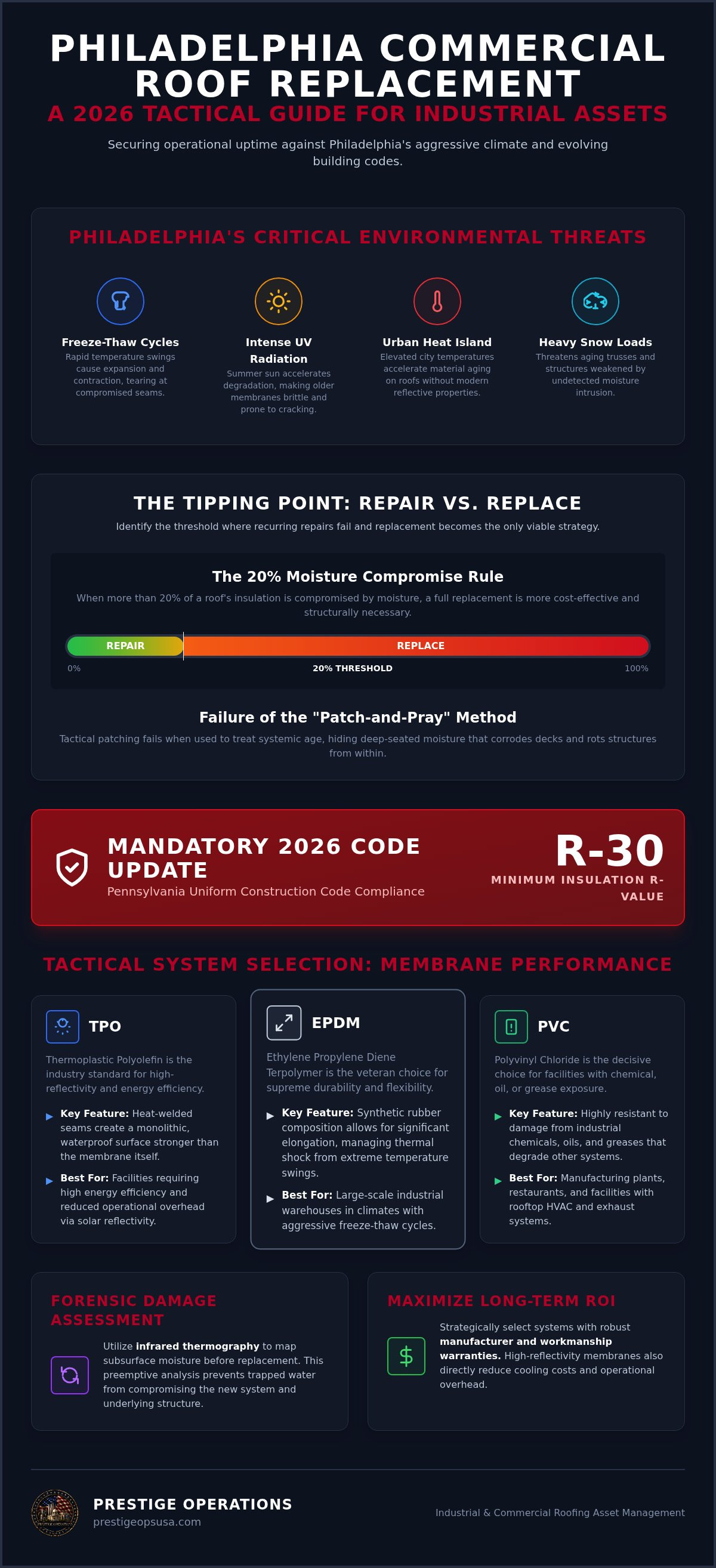
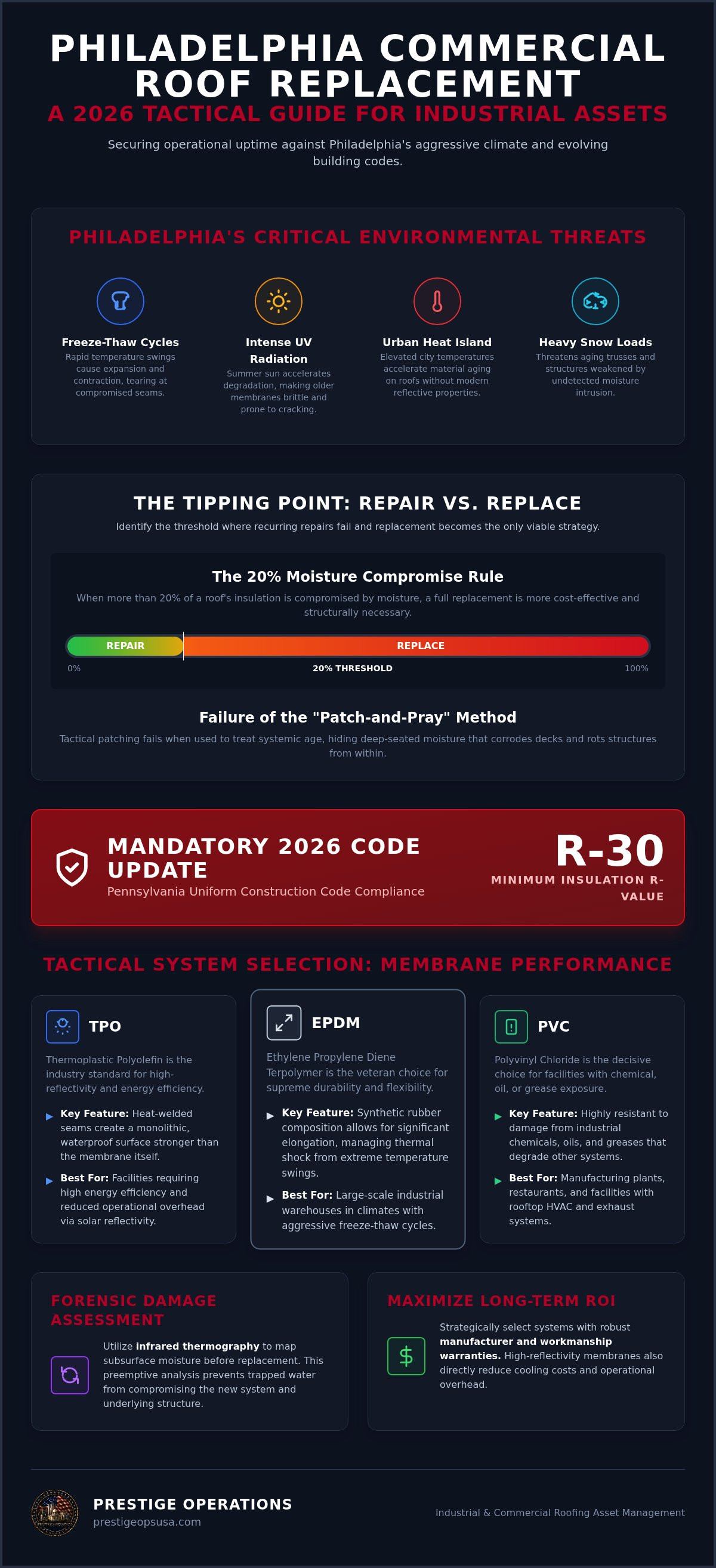
- Identify the critical threshold where recurring repairs fail and a full commercial roof replacement Philadelphia becomes the only viable strategy for asset protection.
- Compare the industrial performance of TPO, EPDM, and PVC membranes to ensure your facility survives Philadelphia’s aggressive freeze-thaw cycles.
- Align your infrastructure deployment with the 2026 Pennsylvania Uniform Construction Code, focusing on mandatory R-30 insulation R-values.
- Implement forensic damage assessment techniques like infrared thermography to map subsurface moisture before mobilizing a replacement crew.
- Maximize long-term ROI by evaluating manufacturer versus workmanship warranties and selecting high-reflectivity systems that reduce operational overhead.
Commercial Roof Replacement: When Repair Becomes a Liability
Industrial assets require decisive management. A commercial roof is your primary shield. When repairs become frequent, they aren't maintenance; they're a liability. This transition happens when the cost of temporary fixes exceeds the long-term value of the protection provided. You're no longer preserving the asset. You're subsidizing its decline. Every leak represents a potential interruption to your workflow. If you aren't planning for the lifecycle of the system, you're planning for failure.
Philadelphia’s 2026 weather patterns exacerbate these failures. Intense UV radiation during summer months makes older membranes brittle. Rapid temperature swings in winter cause expansion and contraction that tear at compromised seams. A strategic commercial roof replacement Philadelphia project moves your facility from a state of constant reaction to one of controlled stability. It eliminates the risk of unpredictable downtime. You gain a predictable maintenance schedule and a secure operational environment.
To better understand the risks of heavy rain and aging systems, watch this analysis of Northeast Philly roof leaks:
The Failure of the Patch-and-Pray Method
Tactical patching is useful for isolated damage. It fails when used to treat systemic age. Multiple repair points often hide deep-seated moisture trapped within the insulation. This subsurface water doesn't just sit there. It corrodes metal decks and rots wood structures from the inside out. The 10-20% rule states that when more than 20% of a roof's insulation is compromised by moisture, a full replacement is more cost-effective than continued patching. Beyond this point, the structural integrity of the deck is at risk. You aren't just fixing a leak; you're preventing a catastrophic failure. Modern Commercial Roofing Membranes offer a fresh start with integrated moisture barriers.
Philadelphia Infrastructure Demands
Urban environments like Philly create unique stressors. The urban heat island effect keeps temperatures high, accelerating the degradation of existing membranes that lack modern reflective properties. Heavy snow loads also threaten aging trusses that have been weakened by undetected leaks. Complying with 2026 Philadelphia building codes isn't optional. New standards mandate R-30 insulation values for all commercial roof replacement Philadelphia projects. This requirement significantly increases thermal efficiency. It also stabilizes the interior climate of your facility. Don't wait for a total collapse. Move to a high-performance system before the next freeze-thaw cycle hits. Your infrastructure depends on it.
Tactical System Selection: TPO, EPDM, and PVC Performance
Industrial facilities in the Northeast require membranes that withstand more than just rain. A commercial roof replacement Philadelphia project must account for three primary single-ply systems: TPO, EPDM, and PVC. Each material serves a specific logistical purpose. Selection depends on your facility's exhaust profile, roof slope, and structural load capacity. We don't guess. We analyze the asset requirements and deploy the system that guarantees the longest lifecycle.
TPO (Thermoplastic Polyolefin) is the current industry standard for high-reflectivity requirements. Its heat-welded seams create a monolithic surface that is physically stronger than the membrane itself. For operations focused on chemical resistance, PVC (Polyvinyl Chloride) is the decisive choice. It resists damage from industrial oils and grease that would typically degrade other rubber-based systems. EPDM (Ethylene Propylene Diene Terpolymer) remains the veteran choice for durability. Its synthetic rubber composition allows for significant elongation, managing the thermal shock common in large-scale industrial warehouses. All deployment must adhere to OSHA safety standards to ensure a secure job site during high-altitude membrane installation.
TPO vs. EPDM in the Philadelphia Corridor
Facilities in Reading and Allentown face intense freeze-thaw cycles. EPDM’s black surface absorbs solar heat, which assists in snow melt during harsh winters. However, TPO’s energy efficiency is superior for high-acreage buildings during the humid Philly summers. Maintenance for EPDM focuses on seam inspections, as adhesives can weaken over time. TPO requires less seam maintenance but demands professional cleaning to maintain its reflective properties. Choosing between them requires a 20-year view of energy costs and repair intervals. It's a calculation of total cost of ownership, not just the initial installation.
Industrial Coatings as a Strategic Alternative
Sometimes a full tear-off isn't the first move. High-solids silicone or acrylic coatings can extend a system's life if the underlying substrate is dry and structurally sound. You can learn more about this in our guide on Industrial Roof Coating Allentown: Extending System Life. These coatings act as a tactical shield against UV degradation. They don't fix structural rot. If your insulation is saturated, a coating is a wasted investment. A full commercial roof replacement Philadelphia remains the only permanent solution for compromised assets. For a comprehensive assessment of your facility's specific needs, consult with an industrial roofing expert to evaluate your current system's integrity.
Forensic Roof Analysis: Tactical Damage Assessment
Visual inspections only reveal surface-level symptoms. To protect a high-value industrial asset, you must look beneath the membrane. We employ forensic methods to identify subsurface moisture and core degradation before finalizing any commercial roof replacement Philadelphia plan. This isn't just an inspection. It's a data-driven mapping of the entire roofing system's health. We utilize infrared thermography to detect thermal anomalies. Wet insulation retains heat longer than dry materials. This non-destructive moisture mapping allows us to pinpoint specific failure zones that are invisible to the naked eye.
Structural deck evaluation is the next phase of tactical assessment. Steel decks are prone to rust and corrosion when moisture penetrates the insulation. Concrete decks can suffer from spalling and reinforcement degradation. Wood decks are vulnerable to rot that compromises load-bearing capacity. We assess these substrates to determine if they can support a new high-performance system or if they require structural restoration. The National Roofing Contractors Association (NRCA) provides the technical standards we follow to ensure every assessment meets industry-best practices for safety and durability. We don't guess about structural integrity; we verify it through rigorous field testing.
Core Sampling and Moisture Analysis
Infrared data requires physical verification. We extract physical core samples from the roof to conduct lab-grade moisture analysis. This process reveals "hidden" leaks that bypass standard visual checks. It confirms the depth of saturation and the condition of the vapor barrier. For a deeper look at our diagnostic process, review our guide on Philly Commercial Roof Repair: Tactical Damage Assessment. This forensic approach ensures we don't install a new roof over a failing substrate. It's the difference between a temporary fix and a 20-year solution.
Drainage and Gutter Integrity
A roof is only as effective as its drainage system. We assess secondary drainage, scuppers, and internal drains to prevent catastrophic ponding. Stagnant water is a primary cause of membrane failure in the Philadelphia climate. We also evaluate the capacity of your existing gutter systems. Proper flow is essential for roof longevity. Regular Commercial Gutter Cleaning Philadelphia: Drainage Flow management is a critical component of post-replacement maintenance. We ensure your facility is engineered to shed water with maximum efficiency. This protects the asset from hydrostatic pressure and unnecessary seam stress during heavy Northeast storms.
The Prestige Operations Replacement Protocol
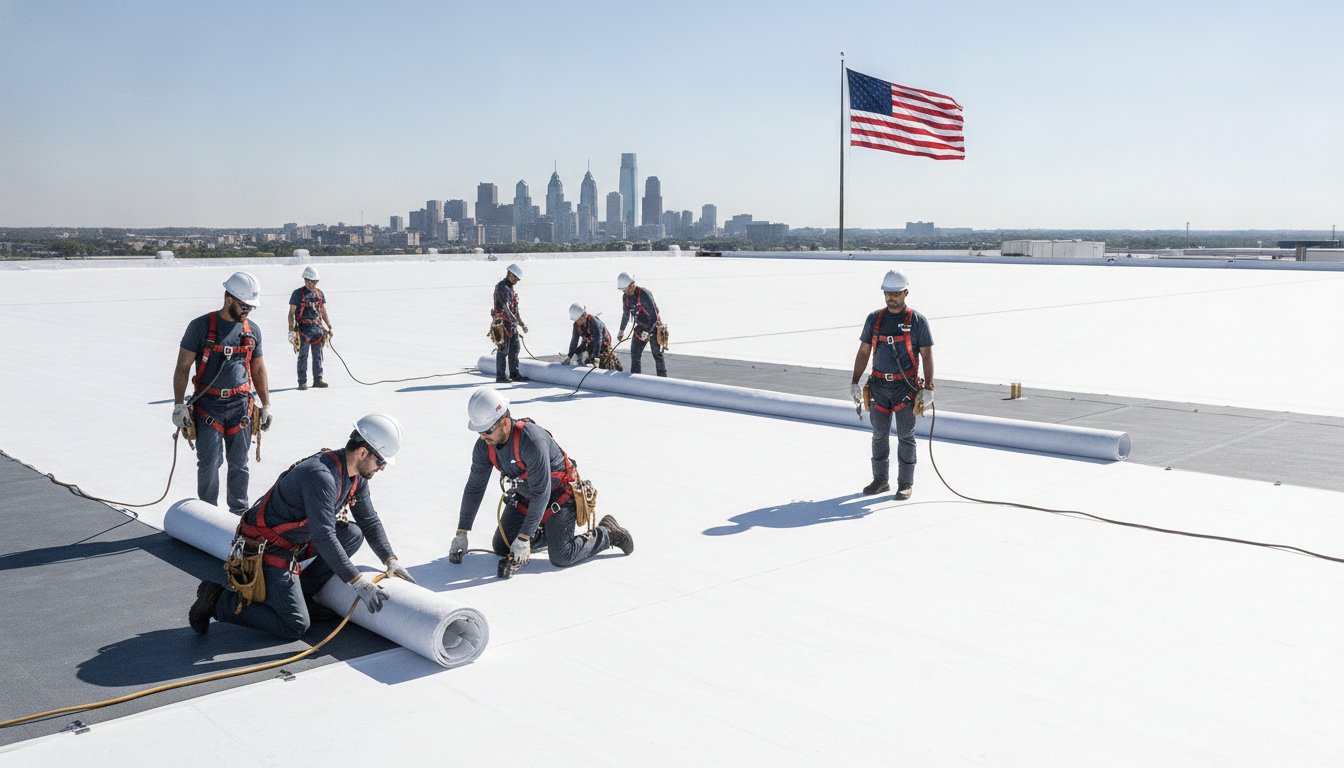
A commercial roof replacement Philadelphia project is a high-stakes logistical deployment. It isn't a standard construction job. We operate with a disciplined five-phase protocol designed to secure your facility without compromising your daily output. Our team functions like a tactical unit on your roof. Every movement is planned to maximize installation speed and minimize the time your building remains open to the elements. Precision is the only acceptable standard for industrial asset protection.
- Phase 1: Mobilization. We establish a secure safety perimeter and crane staging zones. This phase ensures all personnel and equipment are positioned for rapid execution without interfering with facility access.
- Phase 2: Systematic Tear-Off. We remove the failing system in controlled sections. Debris is managed through high-velocity logistics to keep the ground site clear of hazards and functional for your team.
- Phase 3: Substrate Preparation. We verify the structural deck integrity established during forensic analysis. Insulation is then deployed to meet the mandatory 2026 R-30 thermal standards for Philadelphia commercial buildings.
- Phase 4: Membrane Installation. We deploy high-performance TPO or EPDM membranes. Precision seam welding is conducted using automated robotic welders for industrial-strength consistency across the entire roof acreage.
- Phase 5: Certification. A final forensic walk-through confirms every penetration and seam meets our internal standards. We then issue the final manufacturer and workmanship warranty certification.
Logistical Mastery: Minimizing Business Interruption
Your facility must remain operational. We coordinate material staging to avoid disrupting industrial traffic or blocking critical shipping docks. Our logistical team analyzes your facility's traffic patterns before we mobilize. If your operation is high-sensitivity or requires zero daytime noise, we offer night-shift and weekend deployment options. This allows the heavy tear-off and installation work to proceed when your primary staff is off-site. We don't just install a roof; we manage a complex industrial environment to ensure your production numbers stay steady throughout the entire commercial roof replacement Philadelphia process.
Safety and Compliance Standards
Safety is a core operational requirement. We utilize OSHA-compliant fall protection and rigid perimeter security for every project. This protects your staff and our crew from high-altitude hazards. We also monitor air quality and noise levels, especially for office-adjacent roofing sections. Every phase of our work adheres to the strict Philadelphia Commercial Roofing: Asset Protection Standards. This commitment to compliance reduces your liability and ensures a professional job site. To secure your facility with a disciplined industrial protocol, contact Prestige Operations for an asset deployment plan today.
Securing Your Industrial Asset: ROI and Next Steps
A commercial roof replacement Philadelphia is a capital expenditure that must yield a measurable return. You aren't just buying a membrane; you're securing a 20-year asset lifecycle. High-reflectivity systems like TPO and PVC reduce thermal load on your facility’s HVAC equipment by reflecting UV radiation rather than absorbing it. By adhering to the 2026 R-30 insulation standards, you minimize heat transfer and significantly lower operational overhead. This isn't a theoretical benefit. It's a calculated, long-term reduction in facility energy consumption and equipment wear.
Warranty structures provide the final layer of tactical asset protection. We distinguish between manufacturer and workmanship guarantees to ensure comprehensive coverage. A manufacturer warranty covers specific material failure or premature membrane degradation. A workmanship warranty covers the technical execution of the installation, including the precision of heat-welded seams and perimeter flashing. Industrial operators require a rigorous combination of both to eliminate financial exposure. We don't leave your protection to chance; we certify every deployment to ensure full compliance with manufacturer mandates.
Lifecycle Management and Maintenance
Installation is only the first phase. Protecting your investment requires a disciplined post-replacement maintenance strategy. We schedule bi-annual inspections to clear drainage paths and check for physical damage from severe weather. You can review our specific protocols in the Preventative Roof Maintenance Plan: Allentown Facilities. Consistent documentation of these inspections is often a mandatory requirement for maintaining manufacturer warranty validity. We provide the forensic reporting necessary to keep your coverage intact and your asset functioning at peak efficiency.
Initiating the Assessment
Securing your facility starts with a professional site evaluation. Contact Prestige Operations for a boots-on-the-ground assessment of your current system’s structural integrity. Prepare your facility data, including total roof acreage, current membrane type, and original installation dates, to facilitate an accurate tactical quote. We analyze your structural load capacity and local weather exposure to design a system that survives the Philadelphia corridor. Don't wait for the next major storm to compromise your production schedule. Execute a commercial roof replacement Philadelphia that transforms your roof from a recurring maintenance liability into a stabilized, energy-efficient industrial asset. To begin your facility evaluation, contact Prestige Operations for an asset deployment plan today.
Deploying Your 20-Year Industrial Shield
Transitioning from reactive patching to a full-scale commercial roof replacement Philadelphia is a decisive move for any facility manager. You've seen how forensic analysis and infrared mapping reveal the true state of your substrate, moving beyond surface-level guesses. By selecting high-performance TPO or EPDM membranes, you align your infrastructure with the 2026 building codes while securing significant energy efficiency gains. This strategic deployment protects your facility from the aggressive freeze-thaw cycles common in the Northeast corridor.
Prestige Operations brings industrial-strength reliability to every project. We provide boots-on-the-ground expert assessments and demonstrate total mastery of TPO and EPDM systems to ensure your facility remains leak-free for decades. Our disciplined protocol minimizes business interruption, allowing your production to continue without delay. Don't wait for the next major storm to compromise your production line. It's time to stabilize your asset and eliminate operational risk with a partner who understands high-stakes logistics. Request a Tactical Commercial Roofing Quote today to begin your facility's transformation. We're ready to secure your infrastructure for the long term.
Frequently Asked Questions
How long does a commercial roof replacement take for a typical Philadelphia warehouse?
A commercial roof replacement Philadelphia project for a typical warehouse varies based on square footage and roof complexity. Most industrial deployments take between one to three weeks. We utilize a phased mobilization protocol to ensure the facility remains weather-tight throughout the process. Staging materials on-site before the tear-off begins allows our crew to move with maximum efficiency, reducing the total duration of on-site labor.
Can I install a new roofing system over the existing one to save costs?
Installing a new roofing system over an existing one is possible if the building currently has only one layer. Pennsylvania building codes generally permit a maximum of two roofing layers. However, we only recommend this if forensic moisture mapping confirms the underlying insulation is dry. If more than 20% of the existing system is saturated, a full tear-off is the only way to protect the structural deck from long-term corrosion.
What are the most durable roofing materials for the Philadelphia climate in 2026?
TPO and EPDM are the most durable options for the Philadelphia climate. TPO offers superior UV resistance and heat-welded seams that withstand intense summer heat. EPDM is a synthetic rubber membrane that excels during the aggressive freeze-thaw cycles seen in the Northeast. For facilities dealing with industrial grease or chemical exhaust, PVC membranes provide the necessary resistance to prevent premature material degradation and seam failure.
Will my business need to close during the commercial roof replacement process?
Your business doesn't need to close during the replacement process. We coordinate with facility managers to stage equipment and debris management away from primary shipping docks and employee entrances. Our team can execute high-noise phases during night shifts or weekends to maintain full operational output. This logistical mastery ensures that your industrial production continues without interruption while we secure the building envelope with a new high-performance roofing system.
What is the difference between a manufacturer warranty and a contractor guarantee?
A manufacturer warranty covers the roofing materials against defects or premature aging for a specific term, often 20 years or more. A contractor guarantee, or workmanship warranty, covers the technical execution of the installation. This includes the integrity of the seams, flashing, and penetrations. Industrial operators should secure both to ensure total asset protection. We certify every deployment to meet the strict standards required by major membrane manufacturers.
How do Philadelphia building codes affect commercial roof insulation requirements?
Effective January 1, 2026, Philadelphia adopts the 2021 International Energy Conservation Code. This update mandates a minimum insulation value of R-30 for commercial roofs where insulation is entirely above the deck. This requirement significantly impacts the design of a commercial roof replacement Philadelphia project. It necessitates thicker insulation layers, which improves thermal efficiency and stabilizes the interior climate of large-scale industrial facilities while reducing monthly energy overhead.
What are the signs that a commercial roof needs replacement instead of repair?
Replacement is necessary when recurring repairs fail to stop moisture infiltration or when the roof reaches the end of its design life. Signs include widespread seam failure, persistent interior leaks after heavy rain, and visible deck corrosion. If infrared thermography reveals that subsurface moisture has compromised more than 20% of the insulation, tactical patching is no longer cost-effective. A full system deployment becomes the only way to restore structural integrity.
Does Prestige Operations handle industrial roof replacements in Allentown and Reading?
Prestige Operations provides comprehensive industrial roofing services across Philadelphia, Collegeville, Allentown, and Reading. We specialize in large-scale asset protection and logistical management for complex industrial environments in these regions. Our teams are equipped to handle the specific climate stressors and building codes unique to the Pennsylvania corridor. We act as a strategic partner for facility managers seeking reliable, boots-on-the-ground roofing expertise and long-term infrastructure stability.