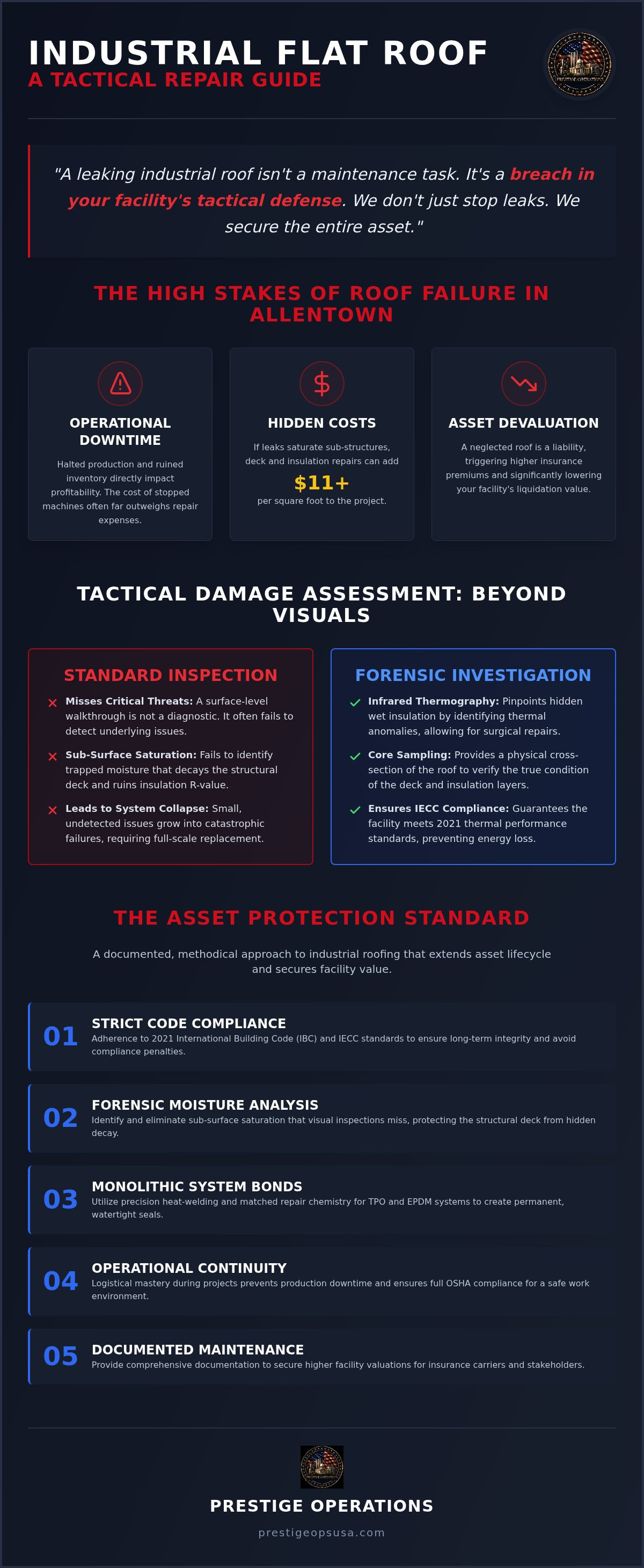
A leaking industrial roof isn't a maintenance task. It's a breach in your facility's tactical defense. In the Lehigh Valley, failing to address a compromised membrane leads to immediate operational downtime and wasted capital on temporary patches. Our approach to industrial flat roof repair Allentown ensures your infrastructure remains watertight and compliant with the 2021 International Building Code updates enforced as of January 2026. We don't just stop leaks. We secure the entire asset.
You've likely dealt with inconsistent contractors who offer quick fixes that fail within a single season. It's frustrating to watch capital expenditure vanish into poor workmanship while your facility's integrity remains at risk. This article delivers a roadmap for precise industrial roof repairs that extend your roof's lifecycle and provide documented protection for insurance valuations. We'll examine the deployment of high-performance membranes, the impact of new thermal efficiency standards on insulation, and the methodical execution required to maintain a watertight facility in high-stakes environments.
Key Takeaways
- Effective industrial flat roof repair Allentown requires strict adherence to 2021 building codes to ensure long-term facility integrity and IECC compliance.
- Utilize forensic moisture analysis to identify sub-surface saturation that visual inspections miss, protecting the structural deck from hidden decay.
- Achieve monolithic bonds on TPO and EPDM systems by matching repair chemistry and utilizing precision heat-welding techniques.
- Maintain operational continuity during roofing projects through logistical mastery that prevents production downtime and ensures OSHA compliance.
- Adopt an "Asset Protection" standard to document roof maintenance and secure higher facility valuations for insurance and stakeholders.
The Stakes of Industrial Flat Roof Failure in Allentown
Industrial roofing failure in the Lehigh Valley is a catastrophic event for facility managers. It isn't a minor inconvenience. It's a direct threat to high-value inventory, sensitive machinery, and structural integrity. Allentown industrial facilities face extreme thermal stress. Large roof surfaces absorb massive heat loads during summer and then contract rapidly during winter nights. This constant movement fatigues membranes and weakens seams. If you ignore these early signs, you aren't just delaying a repair; you're inviting a total system collapse.
Operational downtime is the silent killer of industrial profitability. When a leak reaches the production floor, machines stop. Inventory is ruined. For many Allentown operators, the cost of halted production far outweighs the initial price of a patch or localized membrane replacement. Proactive industrial flat roof repair Allentown identifies these vulnerabilities before they compromise your bottom line. Hidden costs, such as deck repairs and insulation replacement, can add $11 or more per square foot to a project if leaks are left to saturate the sub-structure.
Lehigh Valley Climate Factors
The local climate is unforgiving to low-slope commercial buildings. Freeze-thaw cycles in Pennsylvania are particularly aggressive. Water enters small cracks, freezes, expands, and tears the membrane from the inside out. Heavy snow loads add thousands of pounds of pressure to drainage systems that aren't properly maintained. High-velocity winds also target the roof perimeter. If edge metal isn't secured to modern industrial standards, a single storm can peel back large sections of the roofing system, exposing the deck to immediate saturation. This leads to rapid structural degradation that simple surface repairs cannot fix.
Impact on Industrial Asset Valuation
Your roof is a primary indicator of your facility's health during property audits. Industrial asset valuation depends heavily on documented maintenance. Insurance carriers in Allentown are increasingly scrutinizing roof age and condition when setting premiums. A neglected roof is a liability that triggers higher costs and lower liquidation values. Conversely, a roof managed under tactical asset protection standards becomes a strategic advantage. It demonstrates logistical mastery and a commitment to long-term facility integrity. Secure roofing systems are non-negotiable for high-output environments where asset longevity is the goal. Deferred maintenance doesn't save money; it accelerates depreciation and structural decay.
Tactical Damage Assessment: Identifying Industrial Vulnerabilities
A surface-level walkthrough is not a diagnostic. For a high-stakes facility, industrial flat roof repair Allentown begins with forensic investigation. Visual inspections often miss sub-surface saturation that compromises the insulation's R-value and accelerates structural deck corrosion. Under the 2021 International Energy Conservation Code (IECC) standards, maintaining specific thermal performance is mandatory. If moisture is trapped beneath the membrane, your facility's energy efficiency plummets before a single drop hits the production floor. We evaluate seam integrity under stress to predict where the next failure will occur. Large industrial footprints are also prone to drainage issues. Ponding water creates static loads that your roof deck wasn't designed to support indefinitely, leading to deflection and eventual structural failure.
Key Indicators of Industrial Roof Distress
Industrial roofs endure heavy foot traffic from HVAC and mechanical maintenance teams. This leads to punctures and tears in TPO or EPDM membranes that remain invisible to the untrained eye. Blistering and ridging are critical warnings. They signal that moisture is already trapped within the system, expanding during Allentown's freeze-thaw cycles. We also examine flashings at vents, skylights, and parapet walls. These junctions are the most common points of failure in complex industrial configurations. Identifying these vulnerabilities early prevents a localized patch from turning into a full-scale replacement. Every puncture is a gateway for water that eventually destroys the insulation's thermal resistance.
Forensic Assessment Protocols
Precision requires advanced technology. We utilize infrared thermography to locate hidden wet insulation zones by identifying thermal anomalies at night. This allows for surgical repairs rather than broad, unnecessary tear-offs. Core sampling provides a physical cross-section of the roofing assembly to verify the condition of the structural deck and insulation layers. It's the only way to confirm if the deck is still viable or if rust has compromised its integrity. To ensure your facility remains compliant with wind-uplift requirements and OSHA fall protection standards, we perform fastener pull-tests. This data-driven approach confirms that the existing attachment points can withstand high-velocity winds common in the Lehigh Valley. Before committing to a repair strategy, a forensic assessment is the only way to guarantee long-term asset protection and avoid capital expenditure wastage on failed patches.
Industrial Repair Systems: TPO, EPDM, and Performance Coatings
Successful industrial flat roof repair Allentown depends on absolute chemical compatibility. You can't patch TPO with EPDM adhesive. It fails. TPO requires robotic or hand-held heat welding to create a monolithic bond. This fusion is technically stronger than the surrounding membrane itself. For EPDM systems, we utilize high-strength primers and specialized seam tapes. These materials follow strict industry standards for flat roof repair to ensure the assembly withstands Lehigh Valley pressure. Fluid-applied coatings offer a third path. They encapsulate the existing system. This stops leaks without the logistical nightmare of a full tear-off. We deploy these systems with surgical precision to ensure zero disruption to your production schedule.
TPO vs. EPDM for Allentown Industrial Facilities
TPO is the preferred choice for modern manufacturing sites. Its white surface provides high solar reflectivity. This helps facilities meet 2021 IECC energy codes by reducing cooling loads significantly. It also resists grease and chemicals common in industrial exhaust. EPDM remains a powerhouse for durability. It handles thermal shock better than almost any other material. It's built for the hail impact and aggressive freeze-thaw cycles common in Pennsylvania. When selecting a system, consider your facility's specific output and long-term valuation goals. For a deeper dive into material selection, see our guide on TPO vs EPDM: Philadelphia Industrial Roof Selection. Both systems offer distinct tactical advantages for large-scale operations.
The Role of Industrial Roof Coatings
Coatings are a proactive asset protection measure. We use high-solids silicone and acrylic systems to create a seamless barrier over your existing roof. This eliminates seams. Seams are the primary failure point in the vast majority of industrial leaks. By reflecting UV radiation, these coatings significantly lower thermal gain. This directly reduces industrial cooling costs and stabilizes interior temperatures for sensitive inventory. Application is fast. It doesn't require heavy machinery or noisy tear-offs. It extends the roof's lifecycle by a decade or more. You're not just buying a repair. You're investing in a renewed asset that performs like a new installation at a fraction of the capital expenditure.
Industrial Execution Standards: Precision Operations in Allentown
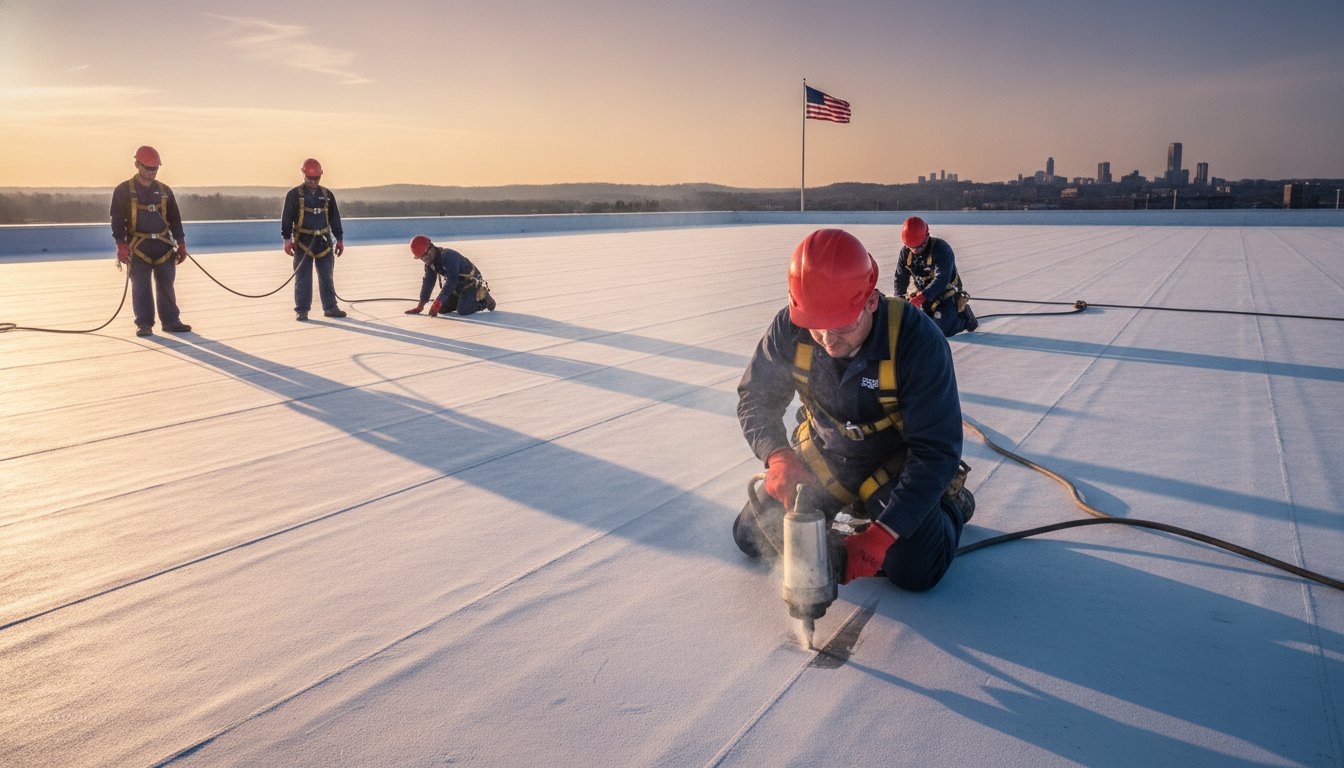
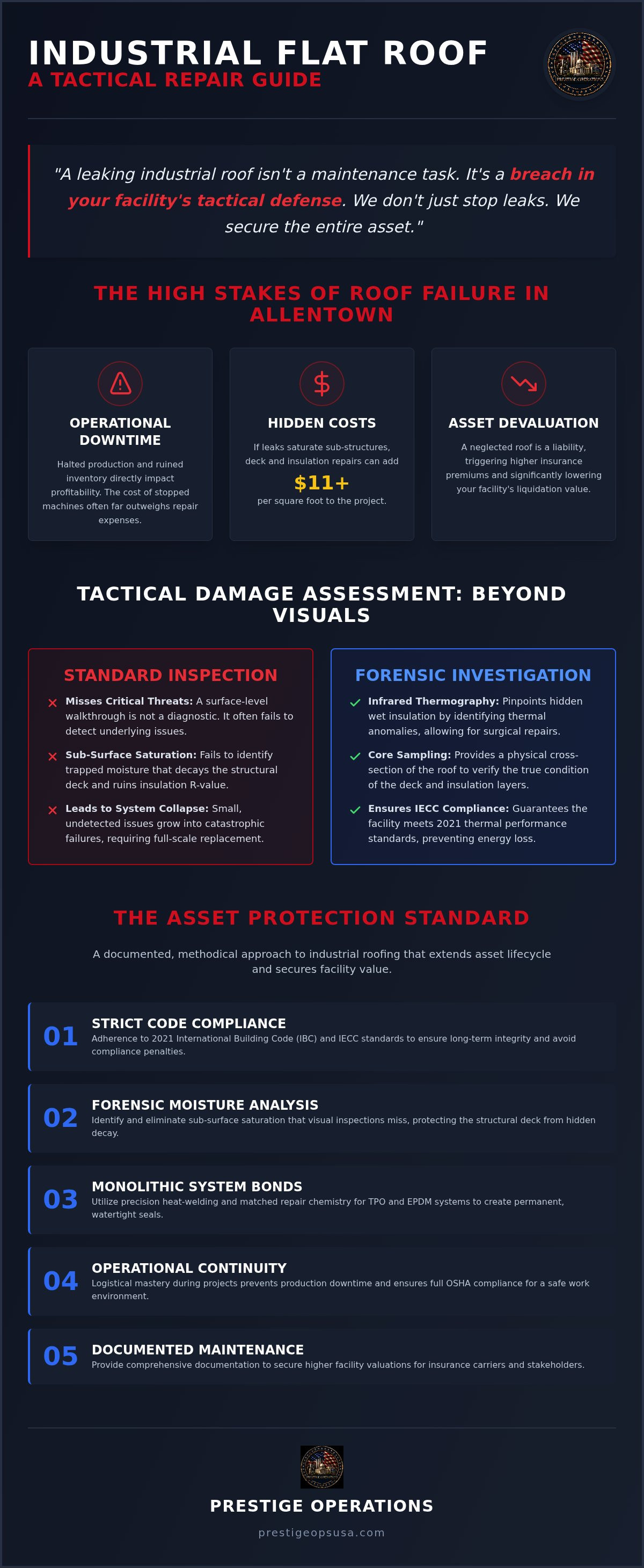
Execution is where strategy meets reality. Operational continuity is the primary objective of every industrial flat roof repair Allentown project. We recognize that a production floor shutdown costs significantly more than the roofing materials themselves. Our teams operate with a "zero-impact" mindset. We coordinate every movement to ensure your facility remains fully functional while we secure the building envelope. This requires more than just roofing knowledge. It demands logistical mastery and a disciplined chain of command. We document quality control at every phase. From the initial membrane prep to the final heat-welded seam, every action is verified against tactical asset protection standards. Precision operations require a clear mental hierarchy of tasks. We don't just fix roofs. We manage a complex industrial project.
Site Safety and Compliance
Industrial roofing is high-elevation, high-stakes work. We enforce strict adherence to OSHA safety standards on every project. This includes the deployment of perimeter safety zones and advanced fall protection systems designed for low-slope industrial environments. A failed safety protocol is as damaging as a failed membrane. When performing industrial flat roof repair Allentown, we prioritize the protection of your personnel as much as the protection of your inventory. Our crews manage debris with precision, ensuring no roofing waste contaminates your facility's exterior or drainage systems. We navigate Allentown’s 2021 IBC and IECC updates with technical expertise. Compliance isn't a suggestion. It's a mandatory requirement for maintaining your property’s legal and insurance standing.
Logistical Mastery and Timing
Material coordination on an active industrial site is a complex operation. We schedule heavy equipment deliveries and crane lifts around your peak-load hours. This minimizes congestion and ensures your logistics flow remains uninterrupted. Every pallet of TPO or EPDM is placed to maximize efficiency and minimize foot traffic on sensitive areas. Weather-contingency planning is a core component of our protocol. We never open more of a roof than can be sealed before a weather event. Dedicated communication lines remain open between our roofing supervisors and your plant managers throughout the project duration. This ensures real-time adjustments based on your operational needs. For a roofing partner that prioritizes logistical precision and asset protection, contact our team today.
Prestige Operations: Allentown’s Industrial Roofing Partner
Industrial flat roof repair Allentown is a mission-critical operation. Prestige Operations delivers industrial-strength reliability and logistical precision to every project site. We recognize that your roof is a primary component of your facility's valuation and operational safety. Our "Asset Protection" standard is designed specifically for high-stakes environments where inventory and machinery must be shielded from the elements. We provide decisive solutions for complex industrial roofing requirements, ensuring that every repair is an investment in the building's future. For facilities requiring a complete system overhaul, we offer advanced Industrial Roof Replacement Allentown PA: Tactical Asset Protection 2026 services that meet the latest building codes.
The Prestige Asset Protection Advantage
Our approach centers on comprehensive roofing solutions tailored to the unique footprints of Allentown industrial sites. We maintain a "boots-on-the-ground" demeanor. This means we prioritize technical competence and physical execution over unnecessary filler. The Prestige advantage is rooted in strategic lifecycle control. We analyze the remaining service life of your current membrane and insulation to determine the most cost-effective path forward. This isn't about selling a service; it's about maintaining facility integrity. We act as a strategic partner, helping you navigate the complexities of industrial asset management with precision. Our expertise in high-stakes facility environments ensures that your roofing system remains a high-performing asset rather than a recurring liability.
Securing Your Allentown Facility
Asset loss begins the moment moisture enters the building envelope. We provide rapid, authoritative response for industrial roof leak repair to prevent catastrophic inventory damage. Our preventative maintenance plans are built specifically for the Lehigh Valley’s climate extremes. We address the freeze-thaw cycles and high-wind loads that compromise low-slope systems over time. Secure your industrial assets now. A tactical assessment from our team provides the data required for informed insurance and valuation documentation. We move with methodical efficiency to identify vulnerabilities and execute repairs that last. Don't settle for inconsistent contractor reliability. Establish a partnership with an unfazed operator capable of handling significant complexity with ease. Your facility's longevity depends on a roof that performs under pressure.
Secure Your Industrial Infrastructure for 2026
Industrial infrastructure requires more than surface-level maintenance. It demands a results-driven approach that prioritizes facility integrity and long-term asset longevity. We've established that forensic assessment and material compatibility are the foundations of successful industrial flat roof repair Allentown. This methodical execution ensures your building envelope remains watertight while meeting the latest 2021 building code standards. You aren't just fixing a leak; you're hardening a strategic asset.
Don't let deferred maintenance turn into capital expenditure wastage. Secure your facility with our proven logistical mastery in high-stakes environments. We provide the technical expertise and Allentown local expertise required to protect your inventory and machinery from the elements. Our Industrial Asset Protection Standards are designed to keep your operations running without interruption. Take the decisive step toward total building security today and ensure your facility remains a high-performing asset for years to come.
Request a Tactical Industrial Roof Assessment in Allentown
Frequently Asked Questions
How much does industrial flat roof repair cost in Allentown?
Total project costs depend on the existing membrane material, the extent of sub-surface saturation, and current code compliance requirements. In Allentown, 2026 standards under the 2021 IECC mandate specific thermal efficiency levels, which often require thicker insulation layers during a repair or partial replacement. Additional factors like tear-off labor, deck repairs, and permits from the Allentown Bureau of Building Standards & Safety will influence the final logistical spend for your facility.
What are the signs that my TPO roof needs immediate repair?
Immediate attention is required if you identify open seams, punctures from HVAC maintenance traffic, or significant ponding water. TPO membranes can also exhibit "bridging" at parapet walls where the material pulls away from the substrate. These gaps allow moisture to bypass the building envelope and saturate the insulation. Identifying these vulnerabilities early prevents the need for a full-scale industrial flat roof repair Allentown operation later in the season.
Can I apply a roof coating instead of replacing my industrial flat roof?
Fluid-applied coatings are an effective alternative if the underlying insulation and structural deck are dry and sound. We utilize forensic moisture analysis to confirm the system's integrity before recommending a coating. If the sub-structure is saturated, a coating will trap moisture and accelerate deck corrosion. When applied correctly, silicone or acrylic systems create a seamless barrier that extends the roof's lifecycle without the disruption of a full tear-off.
How long does a typical industrial flat roof repair take?
Most localized industrial repairs are completed within 1 to 3 days depending on the complexity of the roof's configuration. Large-scale industrial footprints with extensive mechanical equipment or high-velocity wind damage may require additional time for material coordination. We utilize weather-contingency planning to ensure that the building envelope is never left exposed to Lehigh Valley storms. Our goal is to execute the repair with methodical efficiency to maintain your production schedule.
What is the best flat roofing material for manufacturing facilities in Allentown?
TPO is generally the superior choice for manufacturing environments due to its high solar reflectivity and resistance to industrial chemicals or grease. It helps facilities meet Allentown’s energy conservation codes by reducing cooling loads. However, EPDM is often preferred for facilities prone to high thermal shock or hail impact. The best material is determined by your specific output requirements and the technical demands of your facility's high-stakes environment.
How often should I schedule a professional industrial roof inspection?
Professional inspections should occur twice per year, ideally during the spring and fall. These bi-annual assessments allow you to identify damage caused by Allentown's aggressive freeze-thaw cycles before leaks reach the production floor. Regular documentation of your roof's condition is a core component of tactical asset protection. It provides the necessary evidence for insurance claims and helps maintain the overall liquidation value of your industrial property.
Does a flat roof repair disrupt daily industrial operations?
A properly managed industrial flat roof repair Allentown project should have zero impact on your daily operations. We prioritize logistical mastery by scheduling material deliveries and heavy equipment usage around your facility's peak-load hours. By coordinating directly with plant managers, we ensure that safety zones and perimeter securement don't interfere with your logistics flow. Maintaining operational continuity is our primary objective during every phase of the building envelope repair.
What is the difference between commercial and industrial roofing standards?
Industrial roofing standards are more rigorous due to the high-stakes nature of the environment. Industrial roofs face increased mechanical stress from heavy equipment traffic and chemical exhaust that standard commercial roofs don't encounter. Compliance with industrial flat roof repair Allentown protocols requires higher wind-uplift resistance and stricter adherence to OSHA fall protection standards. These systems are engineered for maximum durability to protect high-value machinery and sensitive inventory assets from catastrophic failure.