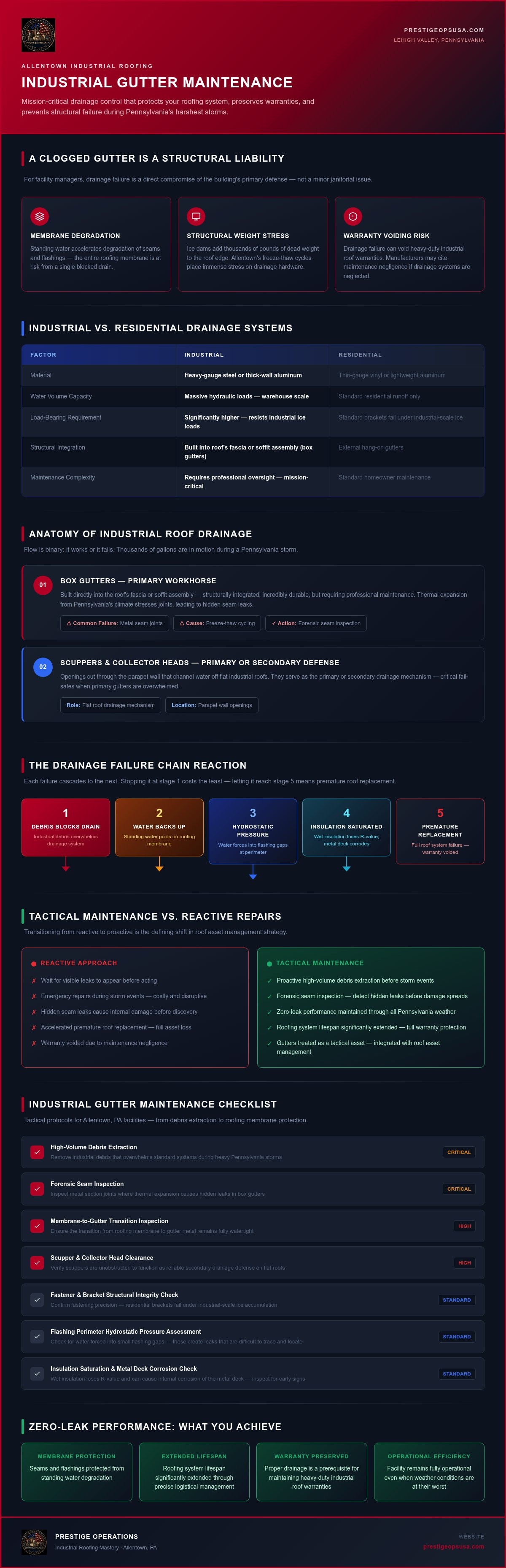
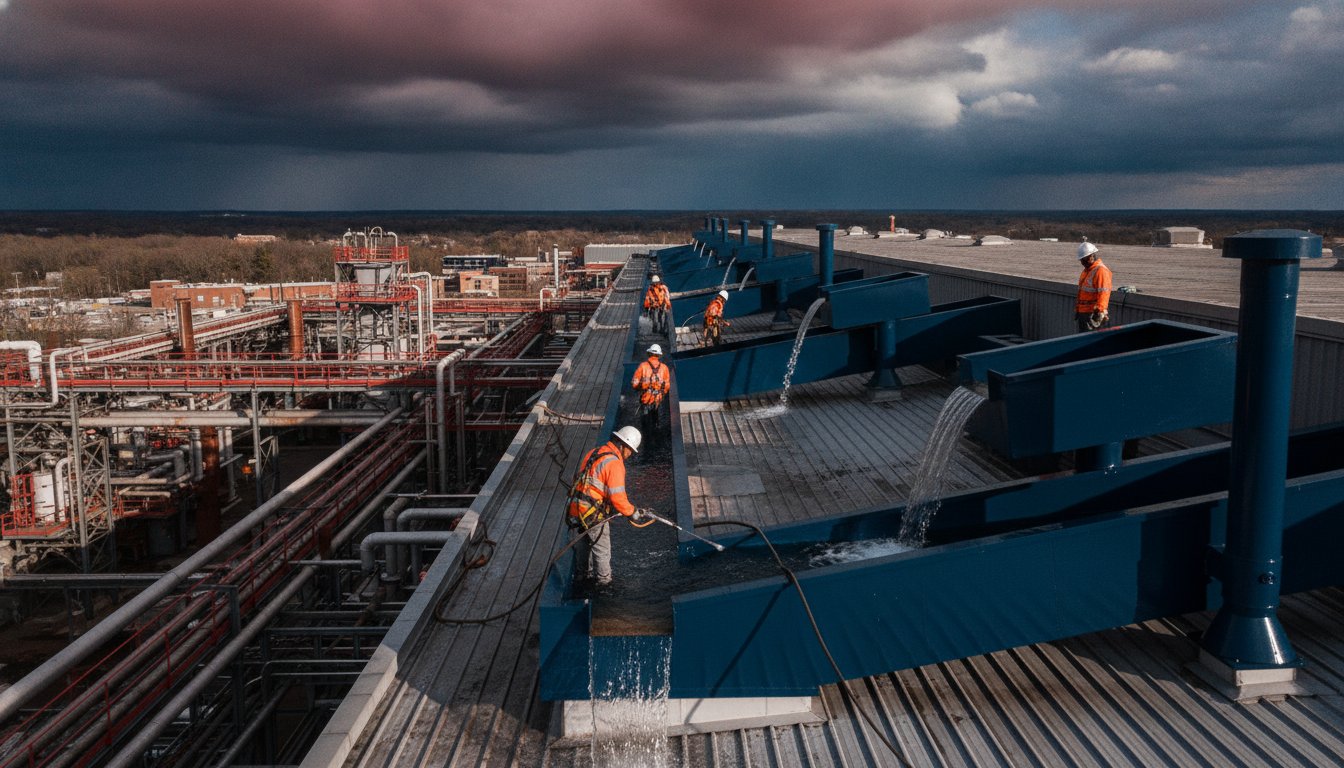
A clogged gutter is not a minor nuisance; it is a structural liability that threatens the entire roofing system. For facility managers, a drainage failure represents a direct compromise of the building's primary defense. Standing water creates unnecessary weight and structural stress, leading to accelerated membrane degradation. In high-stakes environments, industrial gutter maintenance Allentown is a mission-critical operation rather than a simple janitorial task. You understand that debris from nearby industrial operations can quickly overwhelm standard systems during heavy Pennsylvania storms.
This article provides the tactical protocols required to secure your facility's structural integrity. We focus on industrial-strength maintenance designed specifically for the demanding climate of the Lehigh Valley. You'll learn how to achieve zero-leak performance and significantly extend your roofing system's lifespan through precise logistical management. We move beyond basic cleaning to address the technical execution of comprehensive roof drainage control. Our approach ensures operational efficiency remains high even when weather conditions are at their worst. Prepare to transition your roofing strategy from reactive repairs to decisive asset management.
Key Takeaways
- Learn how proactive industrial gutter maintenance Allentown protects your roofing membrane from standing water and structural stress.
- Identify the critical roles of box gutters and scuppers as primary and secondary defense mechanisms against drainage failure.
- Master the logistical link between high-capacity drainage efficiency and the prevention of premature industrial roof replacement.
- Implement tactical debris extraction and safety protocols to maintain zero-leak performance during heavy Pennsylvania storms.
- Transition your facility operations from reactive repairs to a decisive asset management strategy focused on roofing longevity.
What is Industrial Gutter Maintenance in a Roofing Context?
Industrial gutter maintenance Allentown involves more than removing organic debris. It is a systemic cleaning and technical inspection of high-capacity drainage components. In a roofing context, these systems are the primary defense against water infiltration at the roof perimeter. When flow is restricted, water backs up onto the roofing membrane. This creates standing water that accelerates the degradation of seams and flashings. For industrial facilities, this is a mission-critical operation that prevents costly internal damage. We treat every gutter run as a critical extension of the roof deck itself.
Allentown's climate demands a rigorous approach. Heavy snow loads and rapid freeze-thaw cycles place immense stress on drainage hardware. Ice dams in gutters don't just block water; they add thousands of pounds of dead weight to the roof edge. Maintaining these systems ensures that the roofing system functions as designed throughout its entire lifecycle. Proper drainage is often a prerequisite for maintaining heavy-duty industrial roof warranties. If the drainage fails, the manufacturer may void the warranty due to maintenance negligence. Consistent oversight is the only way to ensure continuous protection.
Industrial vs. Residential Drainage Systems
The scale of a warehouse or manufacturing plant in the Lehigh Valley requires specialized engineering. Residential gutters use thin-gauge vinyl or lightweight aluminum. Industrial systems utilize heavy-gauge steel or thick-wall aluminum to handle massive water volumes. The load-bearing requirements at the roof edge are significantly higher. A standard residential bracket will fail under the weight of industrial-scale ice accumulation. Effective industrial gutter maintenance Allentown must account for the massive surface area of these roofs. We focus on the structural integrity of these high-capacity systems to prevent catastrophic detachment during Pennsylvania storms. Precision in material choice and fastening ensures the drainage system stays attached when under extreme environmental stress.
The Role of Gutters in Roof Asset Management
Effective drainage eliminates hydrostatic pressure on the roof perimeter. This pressure forces water into small gaps in the flashing, leading to leaks that are difficult to trace. Integrating gutter care into an industrial roof asset management Allentown strategy preserves the entire roofing assembly. It prevents water from saturating roofing insulation. Wet insulation loses its R-value and can lead to internal corrosion of the metal deck. We treat gutters as a tactical component of the roofing asset, not an isolated exterior feature. Precision maintenance keeps the facility operational and the roofing system secure. By maintaining clear pathways for water, you protect the high-value roofing materials from premature failure and ensure long-term structural reliability.
Anatomy of Industrial Roof Drainage Systems
Industrial roofs don't rely on the lightweight gutters found on residential homes. High-capacity systems are required to manage the massive hydraulic loads of a warehouse or manufacturing plant. The anatomy of these systems is complex, involving structural integration with the roof deck. Effective industrial gutter maintenance Allentown requires a deep understanding of these specific components. Failure in any single part of the chain leads to rapid water accumulation and potential structural stress. Flow is binary: it works or it fails. There's no middle ground when thousands of gallons of water are in motion.
Box Gutter Engineering and Maintenance
Box gutters are the workhorse of Allentown industrial roofing. Unlike external hang-on gutters, these are often built directly into the roof's fascia or soffit assembly. This structural integration makes them incredibly durable but difficult to maintain without professional oversight. Common failure points occur at the seams where metal sections meet. Thermal expansion and contraction in Pennsylvania's climate stress these joints, leading to hidden leaks. Tactical cleaning involves high-volume debris extraction and forensic seam inspection. We ensure the transition from the roofing membrane to the gutter metal remains watertight. If you suspect seam failure, a comprehensive roofing assessment can secure the perimeter before internal damage occurs.
Scuppers and Collector Heads
Flat industrial roofs often utilize scuppers as a primary or secondary drainage mechanism. These are openings cut through the parapet wall that allow water to exit the roof surface quickly. Ensuring unobstructed flow is critical; a single piece of industrial debris can block a scupper and cause massive ponding. We look for forensic damage around the scupper flashings where the roofing membrane is stripped in. Collector heads sit at the base of scuppers to gather water and direct it into vertical downspouts. These components are vital for vertical drainage speed and preventing water from cascading down the building facade. Proper maintenance of these exit points is also a matter of regulatory adherence. Maintaining clear pathways supports EPA stormwater compliance for industrial facilities by ensuring managed discharge during peak rain events.
Commercial downspouts manage high-velocity water discharge away from the building. In an industrial setting, these are large-diameter pipes designed for maximum throughput. They must be securely fastened to the structure to withstand the vibration and weight of rushing water. We inspect the integration points where the downspout meets the collector head and the termination point at the surface level. Every component must work in unison to protect the roofing asset. A breakdown in the downspout chain causes back-pressure that can lift flashings and compromise the roof's edge. Precision in these details is what separates functional drainage from a liability.
Tactical Maintenance vs. Reactive Roof Repair
Waiting for a leak to appear before acting is a tactical error. Reactive repairs cost significantly more than proactive oversight. In an industrial setting, a gutter backup doesn't just wet a wall; it can saturate thousands of square feet of roofing insulation. This leads to a total loss of thermal efficiency and eventual deck corrosion. Implementing consistent industrial gutter maintenance Allentown ensures that water never has the opportunity to stagnate on the roof surface. We prioritize flow to prevent the structural stress associated with standing water.
Proactive drainage control is the single most effective way to prevent a premature industrial roof replacement Allentown PA. When drainage systems are neglected, the roofing membrane is forced to perform a function it wasn't designed for: holding standing water. This constant exposure causes TPO and EPDM seams to fail years before their projected end-of-life. We view maintenance as a logistical safeguard for your most expensive exterior asset. Scheduled oversight allows for the identification of minor roofing issues before they escalate into high-stakes failures.
Identifying Forensic Drainage Failure
Standing water is the primary enemy of modern roofing membranes. It creates a weight load that can deflect steel decking and stress the building's structural frame. In Allentown, clogged gutters are the leading cause of ice damming. When water can't exit through a frozen downspout, it backs up under the roofing flashings and penetrates the building envelope. You might also see vegetation growth in the gutter lines. These roots can physically penetrate the roofing membrane, creating direct paths for water infiltration. Forensic evidence of poor drainage is a clear warning sign that the entire roofing system is under severe duress.
Budgeting for Industrial Roof Longevity
Routine cleaning is a fraction of the cost of a catastrophic leak repair. Beyond the financial savings, scheduled maintenance provides operational continuity. Emergency roofing failures often require facility shutdowns or the relocation of high-value inventory. We focus on extending the lifecycle of the entire roofing system by maintaining clear exit paths for every gallon of precipitation. A dry roof starts with a clear gutter. By prioritizing these tactical protocols, you shift from a cycle of crisis management to a position of logistical control. This strategy ensures that your roofing infrastructure remains a reliable asset rather than a liability.
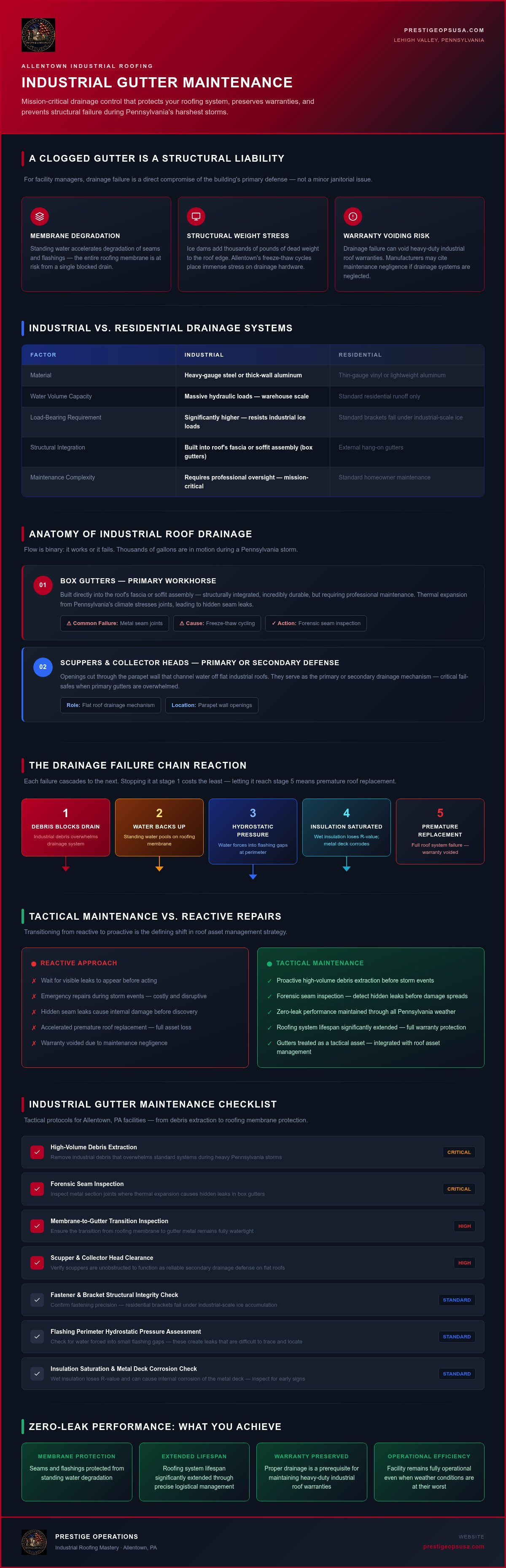
Industrial Gutter Maintenance Checklist for Allentown Facilities
Effective industrial gutter maintenance Allentown requires a structured audit. It isn't a casual walkthrough. It is a mission-critical inspection. We start with safety protocols. High-access industrial roofing demands fall protection and aerial lift coordination. You don't send untrained personnel onto a warehouse perimeter. Once secure, the focus shifts to debris extraction. We remove industrial particulates and organic matter that accumulate from nearby operations. High-capacity drainage systems require thorough cleaning to prevent hydraulic back-pressure during heavy storms.
System testing is the next tactical step. We verify flow through downspouts and underground leads. A blockage deep in the vertical line can cause a backup that saturates the roofing assembly. Forensic assessment follows. We check for corrosion in metal components. We look for loose hangers and seam gaps. These small failures are the precursors to significant roofing damage. Every fastener and joint must be verified for structural integrity. If you identify systemic drainage issues, you need a tactical industrial roofing solution to secure your perimeter.
Seasonal Protocols for the Lehigh Valley
Allentown's climate is volatile. Spring cleanup addresses winter grit and freeze-thaw damage to gutter brackets. Winter ice often pulls hangers away from the fascia. Fall preparation focuses on clearing foliage before the first hard freeze. If gutters are full of wet leaves when the temperature drops, they become solid blocks of ice. Winter monitoring ensures drainage remains clear for snow melt. When the sun hits a snow-covered roof, the runoff must have a clear path. Without it, ice dams form and push water under the roofing membrane.
Technical Inspection Points
We inspect the flashing integrity where gutters meet the roof deck. This transition point is vulnerable to water bypass if the metal has pulled away. Verifying the pitch of industrial box gutters is also essential. Even a slight sag prevents optimal flow and leads to standing water. Finally, we inspect downspout anchors for structural stability. High-velocity water discharge creates vibration. Over time, this vibration loosens anchors and compromises the vertical drainage line. Precision in these technical details ensures the roofing system remains secure and functional through every season.
Prestige Operations: Industrial Roofing Mastery in Allentown
Prestige Operations operates with methodical efficiency. We aren't just contractors; we're strategic partners in industrial roofing asset preservation. Our boots-on-the-ground approach ensures that every square foot of your facility is protected from the top down. In the Lehigh Valley, industrial gutter maintenance Allentown requires a level of logistical mastery that standard roofing companies can't match. We handle the complexity of large-scale infrastructure with precision and scale. Our team provides a serious solution for a serious industry, focusing on execution over narratives.
We understand that a warehouse roof is a massive investment. Protecting that investment requires more than a casual inspection. It requires a decisive partner who prioritizes competence and comprehensive service. Our team moves with speed and execution to address drainage vulnerabilities before they compromise the roofing deck. We provide the technical expertise needed to manage complex roofing assemblies in high-stakes environments. We don't attempt to be your friendly neighbor; we position ourselves as a strategic asset for your facility's physical infrastructure.
Why Industrial Scale Requires Professional Execution
Managing a multi-acre roofing system is a logistical challenge. These large-scale environments feature high-access points and intricate drainage networks that require specialized equipment. We utilize advanced tools to ensure safe, efficient execution without disrupting your facility's operations. Our professional reporting provides a clear mental hierarchy of your roofing drainage health. We don't just clear debris. We provide a technical analysis of your system's performance. This level of detail allows you to make informed decisions about your roofing asset's future. Precision in high-access work is a requirement, not an option.
Secure Your Roofing Asset Today
Direct communication is the foundation of our partnership. We provide a tactical assessment of your facility's current drainage state to identify immediate risks. Our focus is on long-term roofing longevity and operational efficiency. Contact Prestige Operations to secure a decisive roofing management strategy. We prioritize the structural integrity of your building through disciplined exterior maintenance and expert roofing oversight. Don't wait for the next storm to test your drainage. Implement a professional protocol that ensures zero-leak performance year-round. Our team is ready to move immediately to protect your roofing infrastructure.
Execute a Tactical Drainage Strategy
A functional drainage system is the foundation of a secure roofing assembly. Industrial gutters aren't secondary components; they're mission-critical assets that prevent hydrostatic pressure from compromising your roof's perimeter. Neglecting these systems leads to standing water, membrane degradation, and the eventual need for major roofing intervention. In our demanding local climate, consistent industrial gutter maintenance Allentown is the only way to ensure zero-leak performance during heavy Pennsylvania storms. You've seen how debris and ice can turn a minor blockage into a structural liability.
Prestige Operations delivers industrial-strength reliability through specialized roofing expertise and local Allentown operations. We move with the precision and scale required to protect multi-acre facilities. Our team focuses on logistical mastery to keep your roofing system operational and your inventory dry. Don't wait for the next freeze-thaw cycle to expose vulnerabilities in your drainage network. Request a Tactical Roofing Assessment from Prestige Operations to secure your building's structural integrity. Take decisive action to extend the lifespan of your roofing asset today.
Frequently Asked Questions
How often should industrial gutters be cleaned in Allentown?
Industrial facilities in Allentown should schedule cleaning at least twice per year. Spring and fall are critical periods for removing winter grit and foliage. If your building is near heavy manufacturing, you'll need more frequent oversight to handle industrial particulates. Regular cleaning prevents water from backing up under the roofing membrane. We focus on maintaining clear pathways to ensure your roofing system manages heavy precipitation without structural stress or internal leaks.
Can clogged gutters cause an industrial roof to collapse?
Excessive water weight is a leading cause of structural failure on large-scale roofs. Clogged gutters trap thousands of gallons of water, adding immense dead weight to the roof deck. This pressure can deflect steel joists and lead to a catastrophic collapse during heavy storms. Proper industrial gutter maintenance Allentown is a mission-critical safety protocol. We ensure that water exits the roof surface immediately to prevent dangerous accumulation and preserve the building's structural frame.
What are the signs that my industrial box gutters are failing?
Look for forensic indicators like rusted seams, standing water, or vegetation growth in the gutter floor. Water stains on the building's interior fascia or saturated roofing insulation often signal that box gutter seams have failed. These integrated systems are part of the roof's perimeter defense. We check for thermal expansion damage at the metal joints where leaks typically start. Any sign of moisture bypass requires immediate technical intervention to protect the roof deck.
Do industrial gutter guards actually work for large-scale roofs?
Heavy-duty guards can reduce debris but don't eliminate the need for professional inspections. Industrial roofs generate high-velocity runoff that can overshoot standard guards during intense rainfall. In Allentown, ice accumulation often renders lightweight guards useless. We prioritize clear scuppers and high-capacity downspouts over aftermarket filters. If you install guards, they must be industrial-grade steel capable of supporting the weight of snow and ice without detaching from the roof edge.
How does gutter maintenance affect my commercial roof warranty?
Most roofing manufacturers mandate regular drainage maintenance as a condition of the warranty. If a leak occurs due to standing water or a gutter backup, your claim'll likely be denied. Documented industrial gutter maintenance Allentown provides the evidence needed to keep your coverage intact. We integrate gutter care into your overall roofing asset management plan. This proactive approach ensures your warranty remains a valid financial safeguard for your facility's infrastructure.
What is the best way to handle ice dams on an industrial roof in PA?
Prevention's the most effective tactic for managing ice dams in the Lehigh Valley. We ensure gutters are clear of debris in late fall to provide an unobstructed path for snow melt. If dams form, we use specialized extraction methods that protect the roofing membrane from damage. Don't use salt or mechanical hammers, as these can puncture TPO or EPDM surfaces. Maintaining clear vertical drainage allows the roof to shed water safely.
Should I repair or replace my industrial gutters during a roof renovation?
We recommend replacing gutters if they're undersized or showing systemic seam failure during a roof renovation. It's more efficient to install high-capacity drainage while we're already mobilized for roofing work. New gutters ensure that the transition from the roofing membrane to the perimeter metal is completely watertight. If the existing metal is in good condition, we can perform tactical repairs to the seams and hangers to extend their functional life.
What safety standards are required for industrial gutter maintenance?
High-access industrial roofing work requires strict adherence to OSHA fall protection standards. Personnel must use safety harnesses, tie-offs, or aerial lifts when working at the roof perimeter. We prioritize a "boots-on-the-ground" safety culture to manage the risks associated with high-elevation maintenance. Every project involves a logistical assessment of site-specific hazards. Our focus on technical execution ensures that gutter maintenance is performed safely and efficiently without disrupting your facility's daily operations.