A standard coat of paint isn't a strategy for an industrial roof in the Lehigh Valley. It's a temporary mask for an accelerating structural threat. Facility managers in Allentown understand that local industrial particulate matter turns minor surface rust into deep structural pitting faster than almost any other environment. You've seen the recurring leaks at fasteners and the orange streaks at the seams. These aren't just aesthetic issues. They're precursors to structural failure. This guide provides a professional-grade analysis of industrial metal roof corrosion treatment Allentown protocols designed to stop active oxidation and secure your facility's structural integrity.
You need a solution that preserves your asset without halting your production line. We'll outline the tactical stabilization steps required to extend your roof's service life by 10 to 15 years. This isn't about a quick fix. It's about logistical mastery and precision execution to ensure your inventory stays dry and your operations remain uninterrupted. We'll examine the technical requirements for treating compromised panels and reinforcing critical seams against the harsh Pennsylvania climate. Our focus is on functional results and the long-term stabilization of your industrial roofing system.
Key Takeaways
- Identify how Allentown’s humidity and industrial particulates accelerate chemical oxidation on metal roofing systems.
- Distinguish between surface oxidation and deep pitting to assess the structural integrity of your facility's roof.
- Implement an industrial metal roof corrosion treatment Allentown protocol that uses mechanical preparation and chemical stabilization to stop active rust.
- Apply a technical decision matrix to determine if current roof damage warrants targeted repair or a complete system replacement.
- Master the logistics of large-scale roofing maintenance to ensure structural security without halting facility operations.
Industrial Metal Roof Corrosion in Allentown: The Environmental Threat
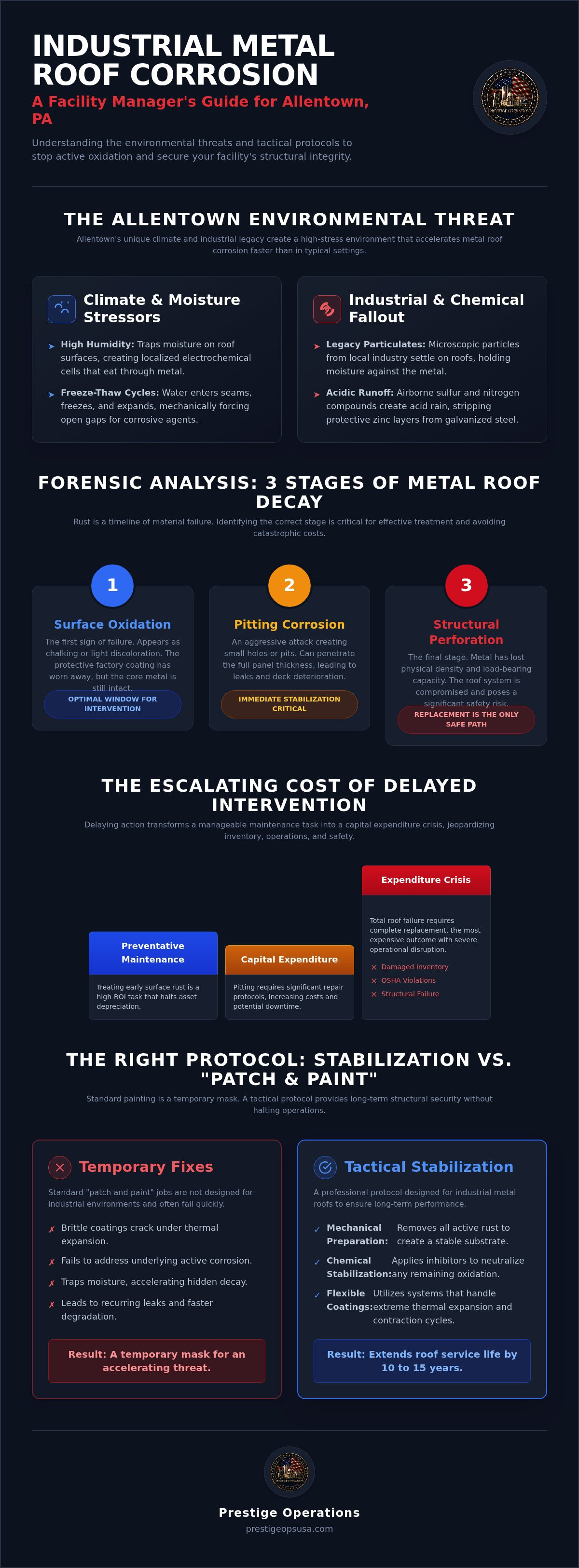
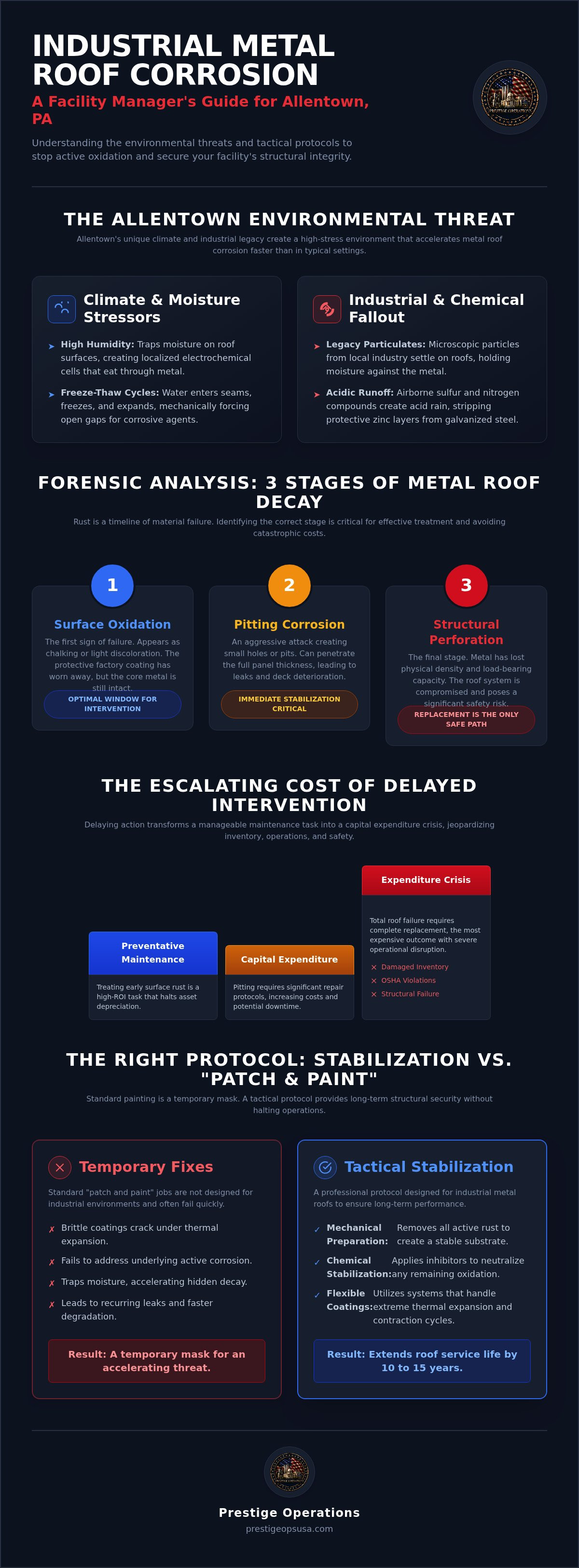
Industrial metal roof corrosion is a relentless chemical oxidation process. It occurs when oxygen and moisture react with the metal substrate. In an industrial environment, this reaction is rarely simple. Airborne pollutants and chemical byproducts act as catalysts. They accelerate the breakdown of protective coatings and the underlying steel. For facility managers in the Lehigh Valley, this isn't a theoretical problem. It's a daily operational risk. Allentown’s unique combination of high humidity and legacy industrial particulates creates a high-stress environment for metal roofing systems. These microscopic particles settle on the roof deck and trap moisture. This creates localized electrochemical cells that eat through metal panels faster than in rural settings.
Standard "patch and paint" repairs often fail on an industrial scale. These quick fixes don't account for the extreme thermal expansion and contraction cycles of large-scale metal systems. A typical warehouse roof can expand and contract significantly during a single Allentown summer day. Brittle coatings crack under this stress. Moisture then enters the new gaps and continues the corrosion process hidden beneath the surface. True industrial metal roof corrosion treatment Allentown requires a tactical approach that stabilizes the metal and remains flexible enough to handle these mechanical movements.
Lehigh Valley Climate Stressors
Allentown’s freeze-thaw cycles are a primary driver of roofing failure. Water enters seams and fasteners, freezes, and expands with immense force. This mechanical action opens paths for corrosive agents to reach the core metal. Local industrial emissions from manufacturing and transport sectors react with galvanized steel. Sulfur and nitrogen compounds in the air create acidic runoff when it rains. This acidity strips away zinc layers and exposes the steel to rapid oxidation. Atmospheric corrosion in Pennsylvania industrial zones is the steady degradation of roofing materials caused by the combined presence of moisture and airborne chemical pollutants.
The Cost of Delayed Intervention
Delayed action transforms a manageable maintenance task into a capital expenditure crisis. Surface rust is the first stage of decay. If left untreated, it transitions into pitting corrosion. This leads to structural perforation where the metal loses its load-bearing capacity. The consequences extend inside the facility. Persistent leaks damage high-value inventory and sensitive electrical systems. They also create slip hazards that lead to OSHA safety violations. Preventative maintenance provides a high return on investment by halting asset depreciation. Treating the roof now prevents the total failure of the roof deck, which costs significantly more than a targeted stabilization protocol.
Forensic Analysis: Identifying Stages of Metal Roof Decay
Effective roofing management requires more than a glance from the ground. You need a forensic approach. Rust isn't a single condition. It's a timeline of material failure. Surface oxidation is the first breach. On industrial metal roofs, this often appears as chalking or light discoloration. It signals that the factory applied protective coating has succumbed to UV radiation and Allentown’s chemical atmosphere. At this stage, the metal substrate remains intact. This is the optimal window for intervention.
Pitting corrosion represents a more aggressive attack. It creates small holes or pits in the metal. This is a strategic threat because it can penetrate the full thickness of a panel while the surrounding area looks relatively healthy. This is where industrial metal roof corrosion treatment Allentown becomes critical. Without immediate stabilization, these pits become conduits for moisture, leading to rapid deck deterioration. Fasteners are often the first points of failure. They experience different expansion rates than the large panels they secure. This movement wallows out fastener holes, creating a reservoir for corrosive runoff. When fasteners fail, the wind uplift resistance of the entire roofing system is compromised.
Structural perforation is the final stage. The metal has lost its physical density and load-bearing capacity. If you can see light through the panels from the warehouse floor, the roof has reached the point of no return. At this stage, chemical stabilization is no longer a viable technical solution. Replacement is the only safe path forward.
Visual Inspection Protocols
Technical inspections must distinguish between white and red rust. White rust, or zinc oxide, indicates that the sacrificial galvanized layer is depleting but still protecting the steel core. Red rust means the steel itself is oxidizing. You must also identify "cut-edge" corrosion. This occurs at the edges of panels where the protective coating was broken during the original installation. Inspecting fastener washers is equally vital. If the EPDM washers are brittle or "mushroomed," the watertight seal is gone, and the fastener shank is likely corroding out of sight.
Structural Integrity Assessment
Determining the health of the metal gauge requires precision. Industry professionals often use ultrasonic thickness testing to quantify material loss. If the panel has thinned beyond 25% of its original gauge, its structural integrity is in question. You must also evaluate the condition of the underlying roof deck and insulation. Saturated insulation holds moisture against the underside of the metal, causing "hidden" corrosion that bypasses surface treatments. A tactical forensic roof inspection is necessary when active red rust covers more than 10% of the total surface area. To secure an accurate data set for your facility, a professional roofing assessment can determine if your system is a candidate for stabilization or requires more intensive measures.
Tactical Corrosion Treatment Protocols
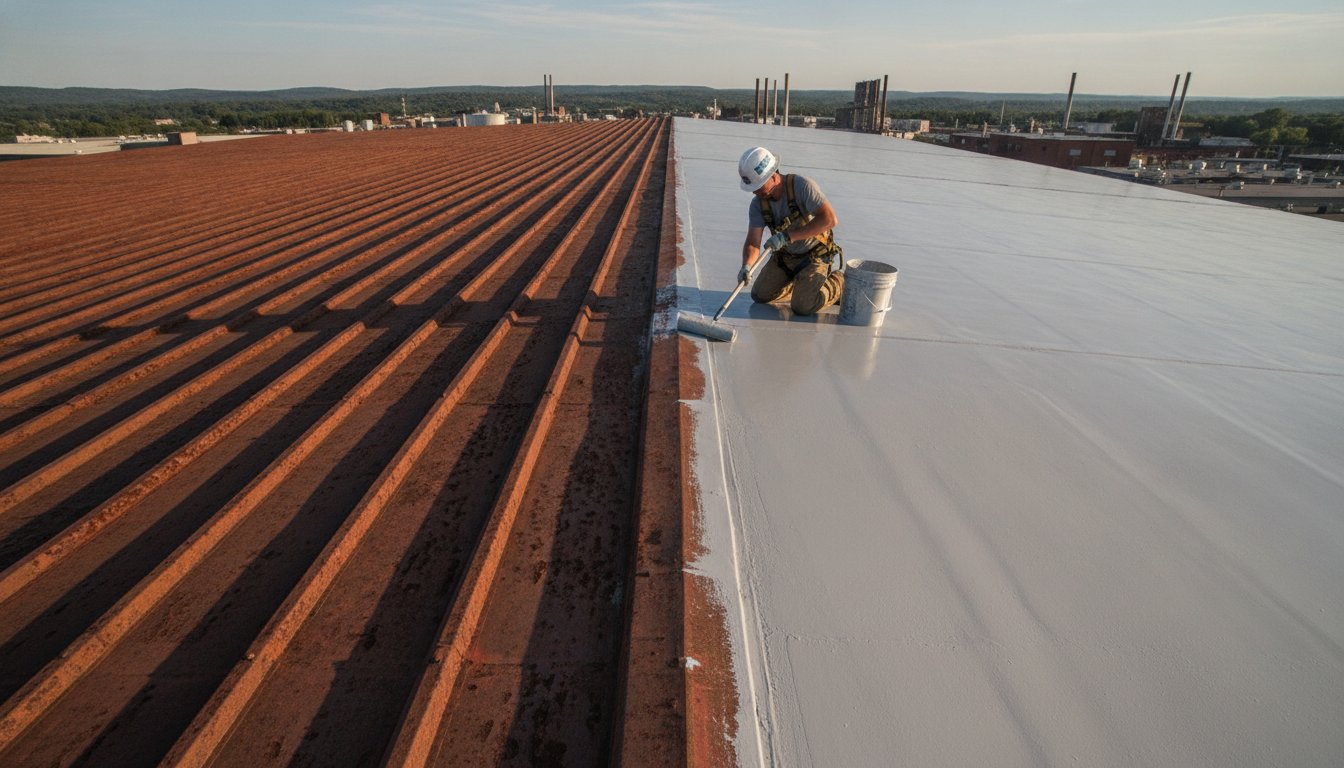
Execution begins where forensics end. A tactical roofing protocol requires a multi-stage approach to stop oxidation and restore the barrier system. Mechanical preparation is the first objective. We use high-pressure industrial water jetting to strip away loose oxidation, failed coatings, and surface scale. This isn't a standard wash. It's a precise removal process that creates a clean, profiled surface for maximum bond strength. Removing the "dead" material is the only way to ensure the new system anchors directly to the structural metal.
Chemical stabilization follows the mechanical cleaning. We apply rust-inhibitive primers designed to chemically neutralize active oxidation. This step is the core of industrial metal roof corrosion treatment Allentown. It converts residual rust into a stable, non-reactive layer. Without this chemical conversion, new coatings will eventually delaminate as rust continues to bloom underneath. Seam reinforcement addresses the mechanical vulnerabilities inherent in large-scale metal systems. We deploy fabric-reinforced sealants across all laps and fasteners. This creates a monolithic, flexible bridge that withstands the Lehigh Valley’s intense thermal cycles without cracking or pulling away from the substrate.
The final stage is the application of high-performance industrial coatings. We utilize high-solids elastomeric or silicone membranes. These aren't standard paints. They're engineered roofing membranes applied in a liquid state that cure into a seamless, rubberized shield. This layer provides the primary defense against the chemical pollutants and high humidity characteristic of the Allentown region. Precision in application thickness is vital. We verify wet film thickness throughout the process to ensure the system reaches its intended service life extension of 10 to 15 years.
Surface Preparation Standards
Adherence to SSPC (Society for Protective Coatings) standards is mandatory for industrial environments. We focus on SSPC-SP1 and SP12 standards to ensure the substrate is free of visible oil, grease, and non-visible contaminants like chlorides. These salts, common in Allentown's industrial corridors, are "rust-starters." They must be fully extracted before any coating is applied. Skipping this step guarantees premature system failure. We prioritize substrate cleanliness to ensure optimal adhesion and long-term protection of the roofing asset.
Advanced Coating Technologies
Selecting the right chemistry is a logistical decision based on roof pitch and ponding risk. Silicone systems offer superior UV resistance and handle standing water without breaking down. They're ideal for low-slope industrial decks. Acrylic elastomeric systems are effective for well-draining roofs and provide high breathability. Both systems offer significant thermal benefits. Reflective industrial coatings can reduce roof surface temperatures significantly, directly lowering HVAC strain and operational costs. We ensure all systems meet manufacturer warranty requirements for industrial-grade applications.
Decision Matrix: Repair, Treat, or Replace?
Facility management is asset management. When facing a corroded industrial roof, the choice between repair, treatment, and replacement depends on a specific set of technical data points. We evaluate the percentage of total surface area compromised by oxidation alongside the structural health of the underlying deck. A minor leak at a fastener doesn't always mandate a new roof. Conversely, a shiny topcoat won't save a perforated deck. Your decision must align with the remaining service life of the facility and the required budgetary cycle. We focus on precision execution to ensure your choice provides the longest possible protection for your investment.
When Treatment is Optimal
Treatment is the most efficient path when the metal substrate remains structurally sound. If red rust coverage is under 25% and limited to surface oxidation, an industrial metal roof corrosion treatment Allentown protocol is the correct tactical choice. This approach allows you to extend the roof's life by over a decade without the logistical burden of a full tear-off. It stops the clock on active decay and reinforces critical seams. This method is ideal for facilities that cannot afford the downtime associated with major structural work. It provides a professional-grade barrier that handles the Lehigh Valley’s climate while maintaining operational continuity.
Leveraging specialized treatment systems also allows for a phased maintenance approach. You can stabilize high-risk zones first to manage cash flow while securing the entire facility. For more information on the transition from maintenance to replacement, see our guide on Industrial Roof Replacement Allentown PA. It details the technical requirements for complete system overhauls in high-stakes environments.
Signs Total Replacement is Mandatory
Total replacement becomes a requirement when the metal has reached structural perforation. If ultrasonic testing reveals significant gauge loss or if the underlying insulation is saturated, a coating will fail. Previous failed coating attempts are another indicator that the substrate is too contaminated for new treatment. At this stage, trying to save the roof is a waste of capital. Replacement allows you to upgrade to modern roofing standards, ensuring insurance compliance and improved energy efficiency through better thermal performance. We coordinate these large-scale projects with logistical mastery to minimize the impact on your interior operations.
Don't guess on the status of your facility's structural integrity. Contact us for a decisive roofing evaluation to determine the most efficient path forward for your building.
Prestige Operations: Industrial Roofing Excellence in Allentown
Prestige Operations is the decisive partner for Allentown's industrial sector. We don't offer generic construction. We provide specialized roofing solutions designed for high-stakes environments. Our approach is strictly results-driven. We recognize that a compromised roof is a direct liability to your bottom line. By focusing exclusively on the roofing trade, we maintain technical expertise that generalists lack. We handle the complexity of large-scale industrial systems with an unfazed, professional demeanor. Every project we undertake is managed with the precision required for heavy-duty asset protection.
Logistical mastery is our baseline. We execute industrial metal roof corrosion treatment Allentown protocols while your facility remains fully operational. We coordinate directly with site managers to ensure our crew and equipment don't obstruct your supply chain or production floor. Our team moves with methodical efficiency. We transition from the initial forensic analysis to the final protective coating without unnecessary delays. This precision minimizes your risk and secures your structural integrity immediately. We manage every phase of the project with a focus on scale, speed, and the functional requirements of your facility.
Our Tactical Approach
We prioritize short-burst efficiency for critical roofing needs. This means we deploy rapidly to mitigate active leaks before they impact your interior inventory or sensitive machinery. Our documentation is comprehensive and data-heavy. We provide clear reporting on the current health of your roofing asset and its projected lifespan. We speak the language of facility management and asset protection. Our communication is direct, serious, and devoid of filler. We focus on functional outcomes and the logistical reality of managing heavy industrial infrastructure. Every report we generate serves as a roadmap for your roof’s long-term stabilization.
Secure Your Industrial Asset
Local expertise is non-negotiable in Pennsylvania’s industrial corridors. Allentown businesses rely on Prestige Operations because we understand the specific chemical and mechanical stresses of the Lehigh Valley. We don't just apply a coating; we stabilize a structural system against legacy pollutants and extreme thermal cycles. Our commitment to the local industrial infrastructure ensures that your facility remains a high-performing asset for years to come. For organizations managing regional portfolios, we also maintain these asset protection standards as a Commercial Roofing Contractor Philadelphia.
Don't wait for surface rust to become a structural failure. Contact Prestige Operations for a Tactical Industrial Roof Assessment to secure your facility today.
Secure Your Facility’s Structural Future
Industrial roofing maintenance in the Lehigh Valley is a matter of precision timing. You've identified the environmental threats and the forensic markers of decay. Now, you must act to stabilize your asset before surface oxidation becomes a structural liability. Implementing a professional industrial metal roof corrosion treatment Allentown protocol is the most efficient way to extend your system's service life by 10 to 15 years. This tactical approach avoids the capital-heavy expense of a total replacement while securing your interior operations.
Prestige Operations brings industrial-strength reliability and boots-on-the-ground Pennsylvania expertise to every project. We manage the complex logistics of large-scale roofing repairs so your production never stops. Our focus is on precision execution and functional results. Don't let active corrosion dictate your facility's operational schedule. We provide the technical mastery required to maintain your infrastructure under the most demanding conditions.
Request a Tactical Industrial Roof Assessment to lock in your facility's integrity and protect your long-term investment. Your roof is your first line of defense; keep it reinforced.
Frequently Asked Questions
How do I know if my industrial metal roof rust is structural?
Structural rust is identified by deep pitting, material loss, or visible perforation of the metal panels. Surface rust is merely a coating failure, but structural decay compromises the load-bearing capacity of the roof deck. We use ultrasonic thickness gauges to measure the remaining metal gauge. If the panel has lost more than 25% of its original thickness, the integrity is compromised and the section likely requires replacement rather than simple treatment.
What is the best corrosion treatment for metal roofs in Allentown?
The most effective industrial metal roof corrosion treatment Allentown facilities can utilize is a multi-stage stabilization protocol. This includes high-pressure mechanical cleaning followed by a chemical rust converter. Once the substrate is neutralized, we apply a high-solids silicone or elastomeric membrane. This creates a monolithic barrier that resists the Lehigh Valley’s humidity and industrial pollutants while remaining flexible enough for thermal expansion.
Can you apply a roof coating over existing rust?
You cannot apply a coating directly over raw, active rust without immediate failure. The loose oxidation must be mechanically removed via high-pressure water jetting to reach a sound substrate. After cleaning, a rust-inhibitive primer is mandatory to chemically stabilize any remaining microscopic oxidation. Skipping these preparation steps ensures that the new coating will delaminate and peel within a few seasons as the rust continues to bloom underneath.
How long does an industrial metal roof treatment last?
A professional-grade industrial metal roof treatment typically lasts between 10 and 15 years. The lifespan depends heavily on the quality of the initial surface preparation and the dry film thickness of the applied membrane. Regular inspections and minor fastener maintenance can further extend this window. This timeline allows facility managers to defer the massive capital expense of a full roof replacement while maintaining a watertight building envelope.
Will industrial roof repair disrupt my facility operations?
Industrial roofing repairs are executed externally and rarely require facility downtime. Our logistical management ensures that staging areas and equipment don't block loading docks or production lines. We coordinate with your site safety officers to maintain operational continuity throughout the project. Interior operations can usually continue at full capacity while we stabilize the exterior roof deck and reinforce critical seams from above.
What is the cost difference between treatment and replacement in Allentown?
Tactical treatment protocols are significantly more cost-effective than a total roof tear-off and replacement. By avoiding the labor-intensive removal of existing panels and the disposal fees for heavy industrial materials, you save substantial capital. Treatment focuses on preserving the existing structural asset. It's a strategic maintenance expense that provides a high return on investment by extending the service life of the roof without the logistical burden of a major construction project.
How does Allentown’s weather affect metal roof corrosion?
Allentown’s weather features extreme freeze-thaw cycles and high humidity that accelerate metal degradation. Water enters fastener holes and seams, expands when frozen, and mechanically opens the system to further moisture. Local industrial particulates settle on the roof and react with rainwater to create acidic runoff. This chemical interaction strips away the protective zinc layer on galvanized panels, leading to rapid red rust formation across the roof deck.
Are industrial roof coatings tax-deductible as maintenance?
Industrial roof coatings are often classified as maintenance or repair expenses rather than capital improvements. This classification can allow for a full deduction in the year the work is performed under current tax codes. Capital improvements like total replacements are typically depreciated over many years. You should consult with a tax professional to confirm how these roofing maintenance costs impact your specific facility's financial reporting and asset management strategy.