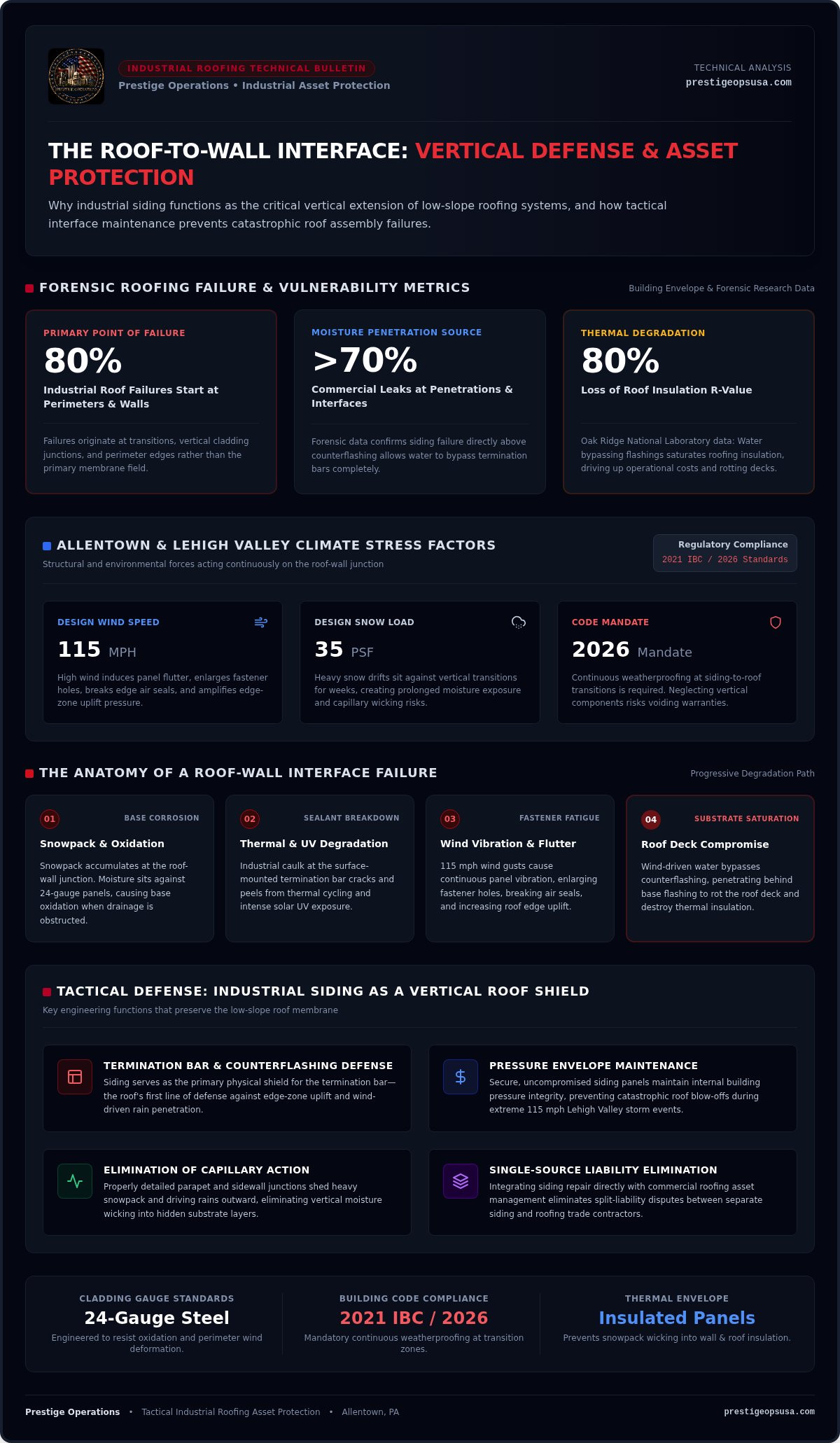
Did you know that up to 80% of industrial roof failures start at the perimeter edges and wall transitions rather than the roof membrane itself? It's a hard reality for facility managers. You likely recognize that your building's exterior must remain sealed, but the vertical components are often neglected until the damage reaches the roof deck. Delaying industrial siding repair Allentown PA does more than hurt your facility's appearance. It creates a direct path for moisture to bypass your counterflashing and saturate your roofing insulation.
Precision is mandatory for a weather-tight industrial shell. You'll learn how tactical siding repair protects your facility’s roofing system and structural integrity against the 115 mph wind speeds and heavy snow drifts common in the Lehigh Valley. This analysis covers the 2026 building code updates, the logistical necessity of integrated flashing, and the methods used to secure the roof-wall interface for long-term asset protection. We prioritize results over aesthetics. Every repair we discuss is designed to keep your roofing system functional and your inventory dry.
Key Takeaways
- Understand why industrial siding acts as the vertical extension of your roofing system and how its failure directly compromises the roof membrane.
- Identify high-risk failure points where corrosion and fastener fatigue lead to moisture infiltration at critical roof-to-wall transitions.
- Implement tactical industrial siding repair Allentown PA to secure termination bars and maintain the continuous weatherproofing required by 2026 building codes.
- Select the right heavy-gauge materials and insulated panels to preserve your roof's thermal performance and prevent snowpack wicking into wall insulation.
- Master the logistical integration of siding and roofing maintenance to eliminate split-liability and ensure comprehensive protection of your industrial assets.
The Critical Link Between Industrial Siding and Roofing System Longevity
Industrial siding is not a cosmetic choice. It is the vertical defense layer for your facility's roofing system. In the high-stakes environment of Allentown logistics hubs, the building shell must function as a single unit. When siding panels degrade, they compromise the roof-wall interface, exposing the roofing substrate to moisture. This is why industrial siding repair Allentown PA is a critical component of roof asset management. It prevents the perimeter failures that lead to catastrophic blow-offs and interior damage.
Building envelope forensic studies indicate that over 70% of commercial roof leaks originate at penetrations and interfaces. Siding failure directly above counterflashing is a primary culprit. Water doesn't just sit on the wall; it channels downward, bypassing the termination bar and saturating roof insulation. This compromise reduces thermal resistance by up to 80% according to Oak Ridge National Laboratory data. It drives up operational costs while rotting the roof deck from the inside out.
To better understand the technical requirements of these transitions, watch this professional installation guide:
The Vertical Roofing Extension
The parapet wall serves as the transition point between vertical siding and the low-slope roof membrane. Properly detailed siding directs wind-driven rain away from these sensitive junctions. Without functional cladding, water wicks behind the base flashing through capillary action. This vertical moisture penetration is often invisible until the roofing substrate has failed. Secure siding also maintains the positive building pressure required to keep your roof membrane attached during high-wind events. It acts as a shield for the termination bar, which is the roof's first line of defense against edge-zone uplift.
Asset Protection Standards in Allentown
Lehigh Valley facilities face a rigorous climate. The 115 mph design wind speeds and 35 psf snow loads typical of Allentown demand reinforced siding-to-roof transitions. Under the 2021 IBC standards effective in 2026, continuous weatherproofing at these junctions is a legal and structural mandate. Neglecting these vertical components often voids industrial roof warranties. We treat siding maintenance as a tactical defense strategy. It ensures the longevity of your industrial roof replacement Allentown PA by eliminating the moisture infiltration paths that destroy roofing systems prematurely.
Identifying High-Risk Failure Points in Industrial Exterior Shells
Failures in the industrial shell don't happen in a vacuum. A breach in the vertical cladding is the starting point for roof membrane degradation. In Allentown's industrial corridors, 115 mph design wind speeds and 35 psf snow loads put extreme stress on the roof-wall interface. Identifying these vulnerabilities before they compromise the roofing substrate is mandatory for logistical continuity. This is why proactive industrial siding repair Allentown PA is a core component of asset management.
Corrosion at the base of metal panels is a top-tier risk. When snowpack accumulates at the roof-wall junction, moisture sits against the metal for weeks. Even 24-gauge steel succumbs to oxidation if drainage is obstructed. This creates a path for water to bypass the roofing counterflashing and enter the building. Fastener fatigue also compromises the shell. In high-wind zones, constant vibration enlarges fastener holes. This leads to panel flutter. It eventually breaks the air seal and increases wind uplift pressure on the roof edge.
Sealant failure at the termination bar is a common entry point for water. Traditional surface-mounted counterflashing relies on industrial caulk. UV exposure and thermal cycling cause this sealant to crack and peel. Once the seal breaks, wind-driven rain is forced behind the roof's base flashing. Impact damage from facility operations also creates breaches. A forklift strike deforms a panel. It creates a gap that allows moisture to saturate the roof insulation.
Thermal Expansion and Contraction
Industrial metal siding moves differently than roofing membranes. During Allentown's temperature swings, this differential movement creates stress at the roof-wall junction. You'll often see fasteners backing out in large warehouses. It's a clear sign the building's structural seal is failing. If fasteners are loose, your roof-wall transition is no longer weather-tight. Precision in fastener selection and spacing is the only way to mitigate this movement.
Moisture Infiltration Indicators
Forensic analysis of interior walls reveals staining patterns that trace back to siding breaches. Hidden rot is common behind insulated metal panels. These panels trap moisture against the roofing substrate. Gaps in the siding allow water to penetrate the building envelope. This leads to roof insulation saturation. Executing industrial siding repair Allentown PA at the first sign of panel fatigue saves the roof deck from rot. Look for these specific indicators:
- Staining on interior walls near the roofline
- Fasteners protruding from metal panels
- Visible gaps at the termination bar
- Dampness in roofing insulation near the building perimeter
If you suspect a compromise, a professional assessment of your industrial exterior can prevent a roofing disaster.
Tactical Siding Repair Protocols: Preventing Roof Flashing Failures
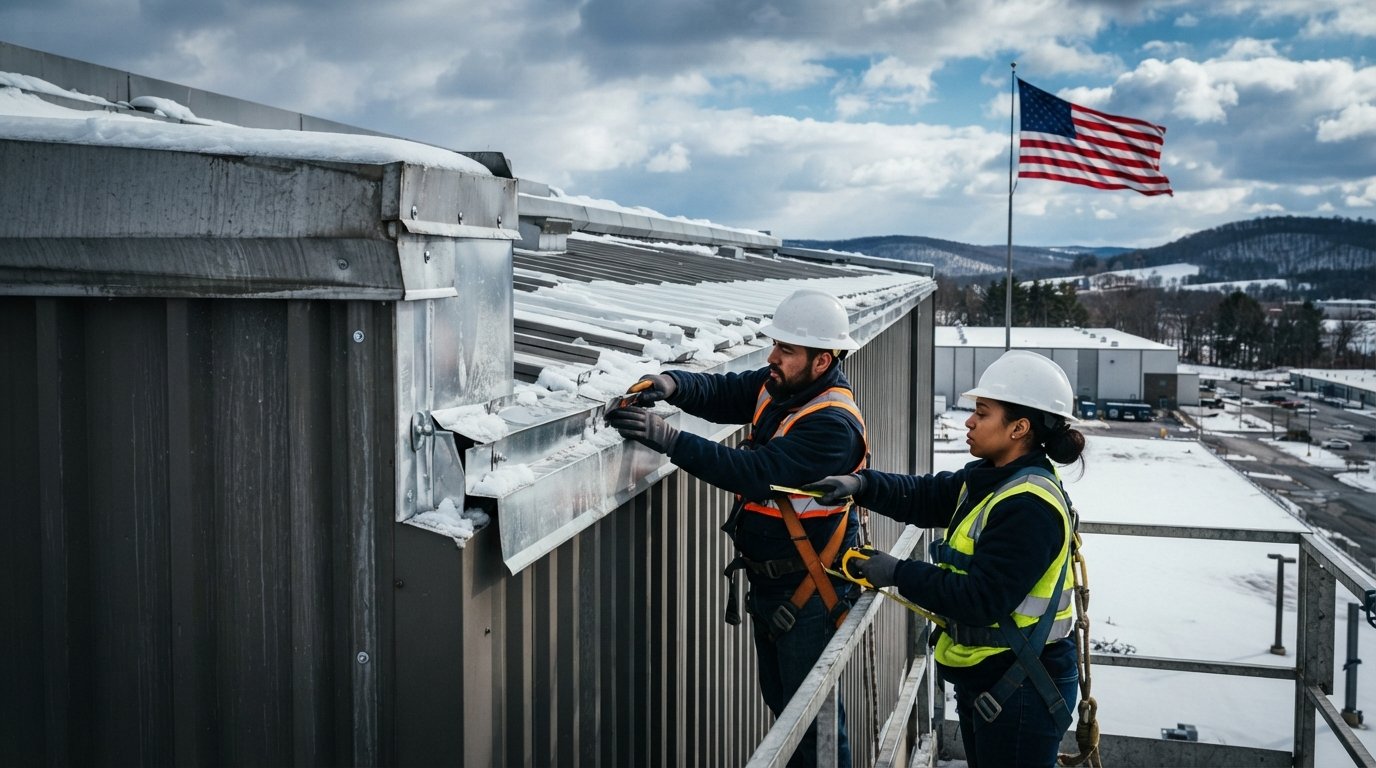
Execution is the difference between a secure facility and a failed roofing system. Standard siding contractors often overlook the mechanical relationship between vertical cladding and the roof membrane. Tactical industrial siding repair Allentown PA requires a roofing-first perspective. We focus on the termination bar. This bar is the primary mechanical anchor for your roof's base flashing. If siding panels are loose, the termination bar is exposed to wind-driven rain and mechanical stress. Securing this interface is our priority.
Replacing damaged panels requires surgical precision. You can't just rip off old metal. Doing so risks tearing the underlying roof membrane or compromising the counterflashing seal. Executing industrial siding repair Allentown PA with a focus on edge-zone stability prevents membrane delamination. We utilize two-piece reglet systems where possible. These allow for panel removal without disturbing the roof's primary water seal. All penetration points receive industrial-grade polyether or silicone sealants. These materials withstand the UV exposure and thermal cycling typical of the Lehigh Valley. We also reinforce corner caps and transition trim. These components are critical for meeting the 115 mph wind-uplift requirements of the 2026 building codes.
The Flashing Integration Process
Proper counterflashing is mandatory. We ensure a minimum two-inch clearance between the siding termination and the roof surface. This prevents capillary draw and snowpack wicking. Water-shedding overlap is non-negotiable. Siding must act as a protective skirt over the roof's base flashing. We utilize strategic Z-flashing in industrial wall systems to create a secondary drainage plane. This ensures that any moisture penetrating the outer panel is directed back onto the roof membrane rather than into the wall cavity or roofing substrate.
Logistical Execution in Allentown Facilities
Industrial operations don't stop for maintenance. We prioritize logistical mastery to minimize facility downtime. Our protocols include specialized safety staging for work near active roof systems and high-traffic loading docks. Every repair is designed to integrate seamlessly with industrial roof asset management Allentown strategies. We coordinate siding repairs with roof inspections to ensure the entire building envelope remains code-compliant and weather-tight. This decisive approach secures your physical infrastructure without disrupting your supply chain.
Industrial Siding Material Selection for Maximum Roof Protection
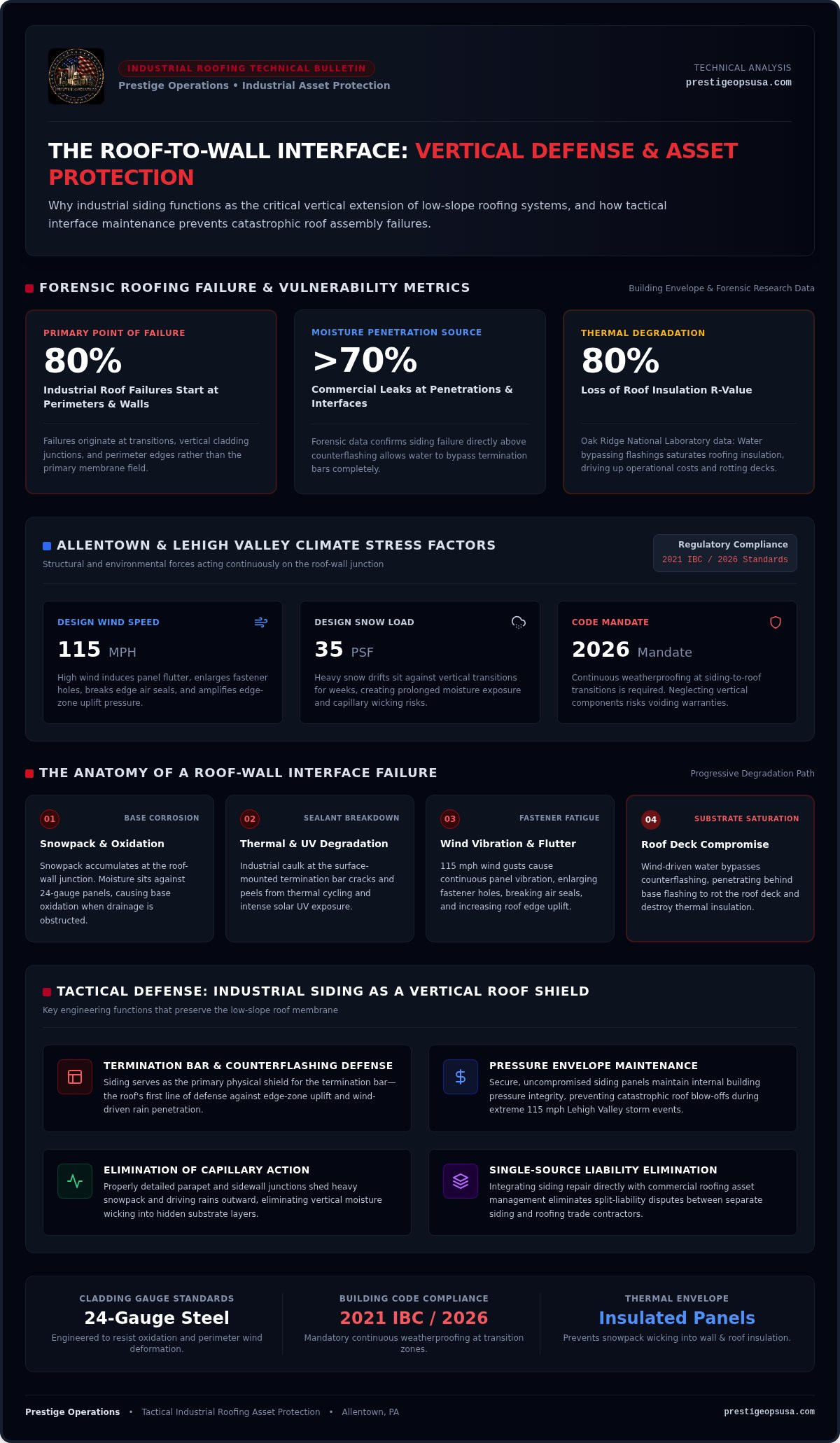
Material selection is a logistical decision. In Allentown, residential-grade materials like vinyl fail in high-stakes environments. We specify materials based on their ability to protect the roof-wall interface and maintain structural seals. 24-gauge steel is the baseline for industrial durability. It provides the rigidity needed to maintain the termination bar seal during 115 mph wind events. Aluminum is an alternative for highly corrosive environments. However, it lacks the impact resistance of heavy-gauge steel. Choosing the wrong metal leads to panel deformation. This deformation eventually pulls the counterflashing away from the roofing membrane.
Lehigh Valley industrial hubs require finishes that resist acid rain and UV degradation. We prioritize Kynar 500 (PVDF) coatings for all transition metal. These finishes prevent the surface oxidation that can lead to galvanic corrosion when in contact with dissimilar roofing metals. Proper industrial siding repair Allentown PA must account for these chemical interactions. If you place galvanized steel siding in contact with copper flashing, the interface will fail within seven years. We ensure all vertical materials are chemically compatible with your existing roofing system.
Metal System Specifications
Allentown industrial zones require 24-gauge Galvalume as a minimum standard for wind-uplift resistance. This thickness prevents panel flutter during high-velocity storms. We utilize stainless steel fasteners with EPDM washers to ensure the industrial shell remains stable. Corrosion-resistant coatings are mandatory for siding near roof exhaust vents. These vents often release chemicals that accelerate metal fatigue. Fastener spacing is calculated based on ASCE 7-16 standards. This precision ensures your siding doesn't become a projectile that punctures your roof membrane during a storm.
Insulation and Thermal Efficiency
Insulated metal panels (IMPs) provide a continuous thermal break. This prevents condensation from forming at the roof-wall junction. When siding lacks proper insulation, it creates a thermal bridge. This bridge causes moisture to accumulate behind the roof flashing. This hidden moisture saturates polyisocyanurate roof insulation, reducing its R-value by up to 80% according to ORNL data. Strategic material selection for industrial siding repair Allentown PA protects your interior climate. It ensures the thermal efficiency of the entire building envelope remains intact. Secure your building's vertical defense by choosing the right industrial exterior materials today.
Fiber Cement and Industrial Integration
Fiber cement has specific applications in industrial environments requiring high fire ratings. However, its weight poses challenges for roof integration. It requires specialized flashing tie-ins to avoid pinning the roof membrane. If the siding is too heavy or improperly fastened, it can put downward pressure on the base flashing. This stress eventually causes the membrane to pull away from the parapet wall. For most Allentown warehouses, metal systems offer superior integration with low-slope roofing. They allow for the thermal movement necessary to keep the roof-wall seal weather-tight through Pennsylvania's freeze-thaw cycles.
Prestige Operations: Industrial Siding and Roofing Integration in Allentown
Managing an industrial building envelope requires more than a general contractor's perspective. It demands a specialized understanding of how vertical and horizontal systems interact under stress. We provide an authoritative approach to industrial exterior shell management. Our focus is the structural integrity of your roofing system. We don't just patch metal panels. We secure the roofing substrate. In the high-velocity wind zones of the Lehigh Valley, this distinction is the difference between a secure asset and a catastrophic failure. Our boots-on-the-ground expertise allows us to navigate the complexities of Pennsylvania industrial environments with precision.
Logistical mastery is our standard. We coordinate industrial siding repair Allentown PA to work in tandem with your broader roofing strategy. This is especially critical during an industrial roof replacement Allentown PA. Replacing a roof without addressing the siding transitions is a tactical error. It leaves the new membrane vulnerable to perimeter moisture infiltration. We eliminate this risk through integrated execution. Our teams manage the staging, safety protocols, and technical tie-ins required for large-scale warehouse and distribution center projects. We operate with a no-nonsense demeanor that prioritizes speed and technical accuracy.
The Prestige Tactical Advantage
We eliminate split-liability. Most facilities hire separate trades for roofing and siding. This creates a gap in accountability at the most vulnerable point of the building: the roof-wall interface. We close that gap. Our direct coordination of siding and roofing repairs ensures that the counterflashing, termination bars, and metal cladding function as a single weather-tight unit. We bring a high level of logistical mastery to every project. This focus on the roofing and exterior maintenance trade means we understand the technical requirements of the 2021 IBC codes effective in 2026. We deliver industrial-strength reliability without the need for unnecessary filler or delays.
Next Steps for Facility Integrity
The 2026 season demands a proactive defense. Allentown facilities facing 115 mph wind speeds and heavy snow drifts cannot afford a compromised exterior shell. We recommend a tactical damage assessment to identify hidden moisture paths at your roofline. Our assessment focuses on the mechanical bond between your siding and roofing system. Following the inspection, we develop a comprehensive exterior shell maintenance plan. This plan secures your industrial assets against thermal cycling and fastener fatigue. Don't wait for a roof leak to address your siding breaches. Secure your perimeter today to ensure your facility remains a high-performing strategic asset.
Secure Your Industrial Exterior Shell for 2026
Your building's vertical cladding is the primary shield for its horizontal roofing system. Neglecting industrial siding repair Allentown PA invites moisture to bypass counterflashing and destroy your roofing substrate. Forensic data confirms that the majority of commercial roof leaks originate at these perimeter transitions. Maintaining the integrity of the termination bar and ensuring proper water-shedding overlap are logistical necessities, not optional upgrades. As 2021 IBC standards take full effect, your facility requires a decisive, integrated approach to exterior shell defense.
Prestige Operations delivers results-driven industrial maintenance with Lehigh Valley logistical mastery. We operate as authorized industrial roofing experts, ensuring your siding repairs support your long-term roof asset management strategy. Don't let a vertical breach compromise your entire roofing investment. Take action to verify your facility's weather-tight status before the next freeze-thaw cycle begins. Request an Industrial Tactical Damage Assessment to protect your physical infrastructure. Your operational continuity depends on a reinforced building envelope.
Frequently Asked Questions
How does industrial siding damage affect my roofing system warranty?
Siding damage often voids roof warranties because it allows moisture to bypass the base flashing and saturate the insulation. Most manufacturers require a continuous building envelope seal to maintain coverage. If siding fails directly above the roof-wall transition, it creates a split-liability scenario that often leads to denied claims. Proactive industrial siding repair Allentown PA ensures that the vertical components don't compromise your roof's warranty status or structural integrity.
What are the signs that siding failure is causing a roof leak in Allentown?
Look for staining on interior walls specifically near the roofline or parapet walls. Visible gaps at the termination bar or fasteners backing out of metal panels are primary indicators of a breach. In Allentown's climate, moisture often travels behind the siding and pools on the roof deck, causing unlocatable leaks. If your roofing insulation is damp near the perimeter but the field membrane is intact, the siding-to-roof interface is failing.
Can industrial siding be repaired without replacing the entire wall?
Individual panels can be replaced or reinforced without a full wall overhaul. We focus on the bottom eight to twelve inches where the siding meets the roof membrane. This area suffers the most from snowpack and freeze-thaw cycles. Targeted repairs involve securing the termination bar, replacing corroded base panels, and applying industrial-grade sealants. This precision approach maintains the roofing system's integrity while minimizing logistical downtime for your facility operations.
Why is the roof-wall transition the most critical part of industrial siding repair?
This junction is the most vulnerable point for water infiltration and wind-uplift failure. It's where the vertical wall cladding meets the horizontal roof membrane. If the transition isn't weather-tight, wind-driven rain is forced behind the counterflashing. Under the 2026 code updates, these junctions require continuous weatherproofing to prevent the roof membrane from delaminating. Securing this interface is the only way to protect the roofing substrate from rot and structural fatigue.
What materials are best for industrial siding in the Lehigh Valley climate?
Heavy-gauge 24-gauge steel with a Kynar 500 coating is the industrial standard for Allentown. These materials resist the 115 mph wind speeds and chemical pollutants found in regional logistics hubs. Insulated metal panels are also highly effective as they eliminate thermal bridges that cause condensation at the roofline. These materials must be chemically compatible with your roofing metals to prevent galvanic corrosion and premature flashing failure at the transition points.
How often should industrial siding and roof flashing be inspected together?
Inspections should occur twice a year, ideally in the spring and fall. Allentown's freeze-thaw cycles put extreme stress on sealants and fasteners at the roof-wall interface. Checking these components together ensures the transition remains secure before peak storm seasons. Regular audits prevent minor siding gaps from turning into major roofing insulation saturation. We recommend coordinating these checks with your scheduled industrial roof asset management program to ensure full building envelope security.
Does Prestige Operations handle siding repair as part of roofing projects?
Prestige Operations integrates siding repair directly into our roofing and exterior maintenance services. We understand that a roof is only as secure as its vertical transitions. Our team manages the technical tie-ins between the wall cladding and the roof membrane to ensure a single, weather-tight unit. This authoritative approach eliminates the coordination gaps often found when using separate contractors for roofing and siding work, providing a decisive solution for complex facilities.
What is the expected lifespan of industrial metal siding in Allentown?
Properly maintained 24-gauge steel siding typically lasts 20 to 30 years, matching the lifecycle of a high-quality industrial roof. However, the lifespan of the roof-wall seal is often shorter, requiring maintenance every 5 to 10 years. UV exposure and thermal cycling in the Lehigh Valley degrade sealants and fasteners more quickly than the panels themselves. Regular industrial siding repair Allentown PA extends the system's longevity and protects the underlying roofing assets.