Your industrial roof isn't just a shelter. It's a high-stakes financial asset that either protects your bottom line or drains it through thermal inefficiency and structural failure. Selecting between TPO vs EPDM roofing Philadelphia is a critical tactical decision for any facility manager facing recurring leaks and skyrocketing summer cooling costs. Pennsylvania's extreme temperature swings demand a membrane that handles rapid expansion without compromising the building's envelope. A failing roof is a liability that threatens equipment, inventory, and operational continuity.
You need a roofing system that functions as a long-term defense strategy rather than a temporary patch. This comparison analyzes the technical performance of these two industry standards to ensure you secure a leak-free facility for over 20 years. We evaluate puncture resistance, weld integrity, and UV reflectivity to determine the optimal protection for your specific Pennsylvania asset. You'll gain a clear understanding of which material reduces energy overhead and lowers maintenance requirements in demanding industrial environments. We focus on results, precision, and the logistical reality of large-scale roof management.
Key Takeaways
- Differentiate between TPO's heat-welded seams and EPDM's adhesive systems to identify the most durable bond for your facility.
- Analyze the tactical performance of TPO vs EPDM roofing Philadelphia to determine which membrane offers the highest ROI against Pennsylvania's intense UV exposure.
- Evaluate how sub-zero winters and extreme freeze-thaw cycles impact membrane elasticity and long-term seam integrity.
- Learn to leverage high-reflectivity roofing membranes to drive down industrial cooling costs and stabilize operational overhead.
- Implement tactical damage assessment protocols to ensure your selected roofing system serves as a long-term defense for your property value.
TPO vs EPDM: Tactical Selection for Pennsylvania Flat Roofs
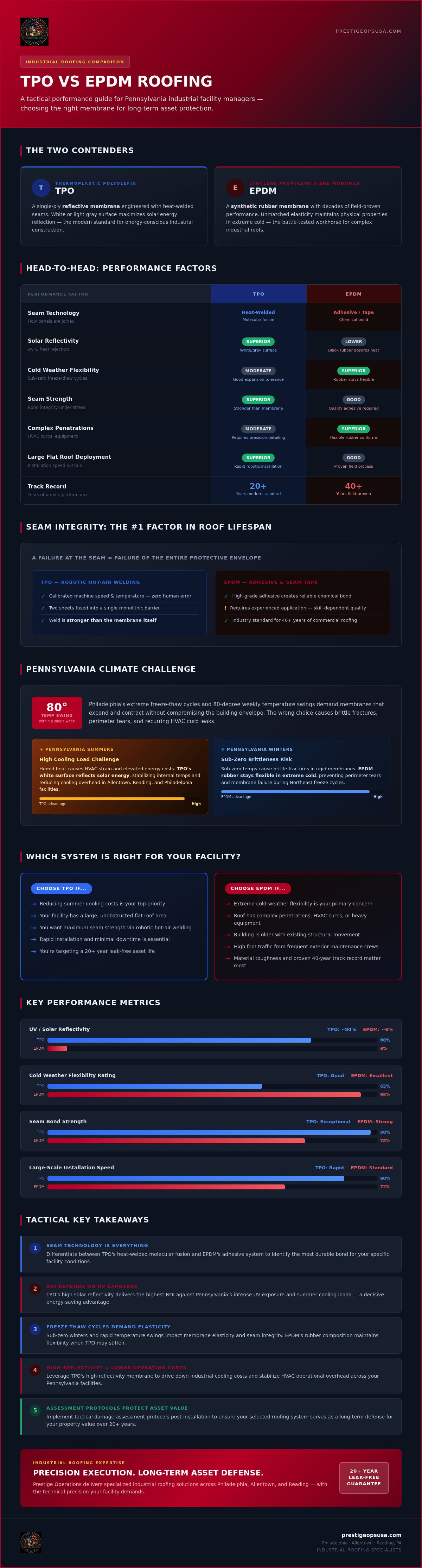
Managing an industrial facility in the Northeast requires a cold-eyed assessment of your infrastructure. Your roof is the primary shield for your building's liquidation value. When evaluating TPO vs EPDM roofing Philadelphia, you aren't just buying a material. You're selecting a long-term defense strategy. The core dilemma involves a trade-off between thermal efficiency and mechanical flexibility. Philadelphia industrial assets demand specialized single-ply solutions that can withstand 80-degree temperature swings within a single week.
General contracting often fails because it ignores the logistical mastery required for large-scale roofing. TPO (Thermoplastic Polyolefin) is a single-ply reflective membrane engineered for heat-welded seams. EPDM (Ethylene Propylene Diene Monomer) is a synthetic rubber membrane known for its extreme weathering capabilities. Both systems offer specific advantages, but the wrong choice leads to recurring leaks and early asset depreciation. Precision in professional execution is the only way to avoid these failures.
TPO: The Reflective Powerhouse
TPO is the modern standard for energy-conscious industrial construction. It's engineered for high UV resistance. The membrane typically comes in white or light gray to maximize solar heat reduction. This is a critical factor for facilities in Allentown and Reading that experience high cooling loads during humid Pennsylvania summers. By reflecting solar energy away from the building, TPO helps stabilize internal temperatures and reduces the strain on HVAC units. It's a decisive choice for lowering energy overhead.
- Molecular Fusion: Seams are heat-welded to create a monolithic, leak-proof barrier.
- Energy ROI: High reflectivity provides a significant reduction in summer cooling costs.
- Industrial Scale: Rapid deployment makes it ideal for large, unobstructed flat roofs.
EPDM: The Proven Rubber Workhorse
EPDM remains a staple for industrial assets due to its decades of field performance. It's a synthetic rubber that maintains its physical properties in extreme cold. Brittle fractures are a common failure point for many roofing materials during sub-zero Reading winters. EPDM stays flexible. It's the preferred choice for roofs with complex penetrations, heavy mechanical equipment, or frequent foot traffic for exterior maintenance.
While EPDM doesn't offer the same solar reflectivity as TPO, its elasticity is unmatched. It expands and contracts without stressing the underlying deck. For older facilities with structural movement, this flexibility prevents the membrane from tearing at the perimeter or around HVAC curbs. It's a durable, no-nonsense solution for high-stakes environments where material toughness is the priority. Don't underestimate the logistical benefit of a material that has survived Northeastern winters for 40 years.
Material Science: Heat-Welded vs. Adhesive Systems
The structural integrity of a flat roof depends entirely on its seams. When comparing TPO vs EPDM roofing Philadelphia, you must evaluate how these systems achieve a watertight seal. TPO membranes are molecularly fused using robotic hot-air welders. This process creates a physical bond where two sheets become one. EPDM systems rely on high-grade adhesives and specialized seam tapes. Both methods are industry standard, but their failure modes and installation requirements differ significantly. Precision in seam execution is the single most important factor in determining the system’s lifespan.
General contractors often treat roofing as a commodity. This is a mistake. Industrial roofing is a specialized discipline of asset management. The logistical mastery required to manage thousands of linear feet of seams demands technical precision. Whether you choose a thermoplastic or a rubber system, the execution phase determines your long-term ROI. A failure at the seam is a failure of the entire protective envelope.
The Welding Advantage
Robotic welding provides a level of consistency that manual application cannot match. These machines move at a calibrated speed and maintain a constant temperature. This precision eliminates the human error factor inherent in hand-seaming. A properly welded TPO seam is actually stronger than the membrane itself. Under stress, the material will typically tear before the weld fails. This mechanical superiority is essential for preventing commercial roof leak repair Philadelphia scenarios that often plague aging industrial assets. Deploying advanced welding technology ensures every inch of the roof is secure against wind uplift and water ingress.
Rubber Adhesion Protocols
EPDM installation is a chemically sensitive process. The adhesives and primers used to bond synthetic rubber require specific environmental conditions. Temperature and humidity windows are narrow. If the air is too damp or the surface is too cold, the bond will not reach full strength. In active industrial zones, dust and airborne debris can contaminate the adhesive before it cures. This leads to seam separation or "fish-mouthing" over time. Effective exterior maintenance programs must prioritize the inspection of these adhesive bonds to catch degradation early.
Aging EPDM seams eventually require supplemental tapes or liquid flashings. While the rubber membrane itself can last 30 years, the adhesives often have a shorter functional life. Successful execution requires a clean, dry, and temperature-controlled application environment. This is why professional execution is non-negotiable. A specialized roofing partner understands that a roof is only as strong as its weakest seam. Tactical damage assessment protocols help identify if an existing adhesive system can be salvaged or if a full thermoplastic upgrade is required for long-term asset protection.
Strategic Comparison: Durability and Industrial ROI
Asset management requires a granular look at material durability beyond simple leak prevention. When analyzing TPO vs EPDM roofing Philadelphia, you must account for the specific mechanical stresses of your facility. Industrial roofs serve as platforms for HVAC units, solar arrays, and heavy exhaust systems. This leads to frequent foot traffic. TPO generally offers higher puncture resistance than standard reinforced EPDM. Its rigid thermoplastic structure handles the impact of dropped tools or heavy equipment maintenance better than the softer rubber of EPDM. Every puncture is a potential entry point for water that compromises your building's structural integrity.
UV degradation rates also vary based on the Pennsylvania climate. Philadelphia's high humidity and intense summer sun accelerate the aging process of inferior membranes. TPO is engineered with powerful UV stabilizers that prevent the material from becoming brittle. While EPDM is naturally resistant to weathering, its dark surface absorbs more thermal energy. This heat absorption can lead to insulation damage over time if the system isn't designed with adequate thermal breaks. Tactical damage assessment protocols are essential to evaluate how your current roof handles these environmental loads.
Chemical and Environmental Resilience
Your facility's exhaust profile dictates your material choice. TPO demonstrates high resistance to fats, oils, and common industrial chemicals. It's the standard for food processing plants or manufacturing hubs where grease is vented onto the roof surface. EPDM is highly susceptible to petroleum-based products. Exposure to grease or oils causes synthetic rubber to swell, soften, and eventually degrade. Selecting a material that matches your operational output is a prerequisite for a commercial roofing estimate Philadelphia that reflects true long-term value. We prioritize material science over generic contracting to ensure your roof survives its specific industrial environment.
Operational Lifespan and Lifecycle Costs
ROI isn't just about the initial install. It's about the lifecycle cost per square foot. TPO systems typically provide a service life of 15 to 20 years. EPDM often exceeds 25 to 30 years if properly maintained. However, the energy savings from TPO's reflectivity can offset its shorter lifespan in high-cooling environments. EPDM's carbon black composition absorbs heat. This can accelerate the degradation of the underlying insulation if not managed correctly. You must factor in the frequency of seam repairs for adhesive systems versus the lower maintenance requirements of heat-welded thermoplastic membranes. Precision execution ensures you don't pay for premature failure. We view the roof as the first line of defense for property liquidation value, and our logistical mastery ensures a high-stakes execution that protects that asset.
Regional Deployment: Philadelphia Freeze-Thaw Cycles
Philadelphia weather is a relentless stress test for industrial infrastructure. In Collegeville, 80-degree temperature swings within a 48-hour window are common. These rapid cycles force roofing membranes to expand and contract violently. When deciding on TPO vs EPDM roofing Philadelphia, you must account for this specific thermal shock. EPDM’s synthetic rubber composition provides superior elasticity. It remains pliable in sub-zero Reading winters, stretching without losing its structural memory. TPO is naturally more rigid. While modern formulations are more stable than early versions, thermoplastic roofs still face higher risks of stress cracking at fastener points during extreme cold. Proper drainage management is non-negotiable in this climate. Ponding water that freezes into thick ice sheets will eventually destroy even the strongest seam through mechanical expansion.
Logistical mastery in the Northeast requires more than just picking a material. It requires a drainage strategy that accounts for ice formation. Standing water on a flat roof doesn't just cause leaks. It adds thousands of pounds of dead weight that can deflect the roof deck. We prioritize the removal of water before it has the chance to freeze. Precision in the execution of tapers and sumps is what separates a strategic asset from a liability. Your roof must be engineered to shed water in the worst conditions Pennsylvania offers.
Winter Tactical Readiness
Ice damming on flat industrial surfaces is a silent killer of property value. It traps water behind frozen barriers, forcing liquid under flashings and into the building envelope. Membrane color plays a tactical role in winter performance. Dark EPDM surfaces absorb solar heat. This accelerates snow melt and helps keep drainage paths clear even on frigid days. White TPO stays cold, allowing ice to persist longer on the surface. As a leading commercial roofing contractor Philadelphia, we evaluate these thermal properties during our damage assessment protocols. Winter readiness is about logistical foresight and ensuring drainage systems don't fail when they're needed most.
Summer Heat Mitigation
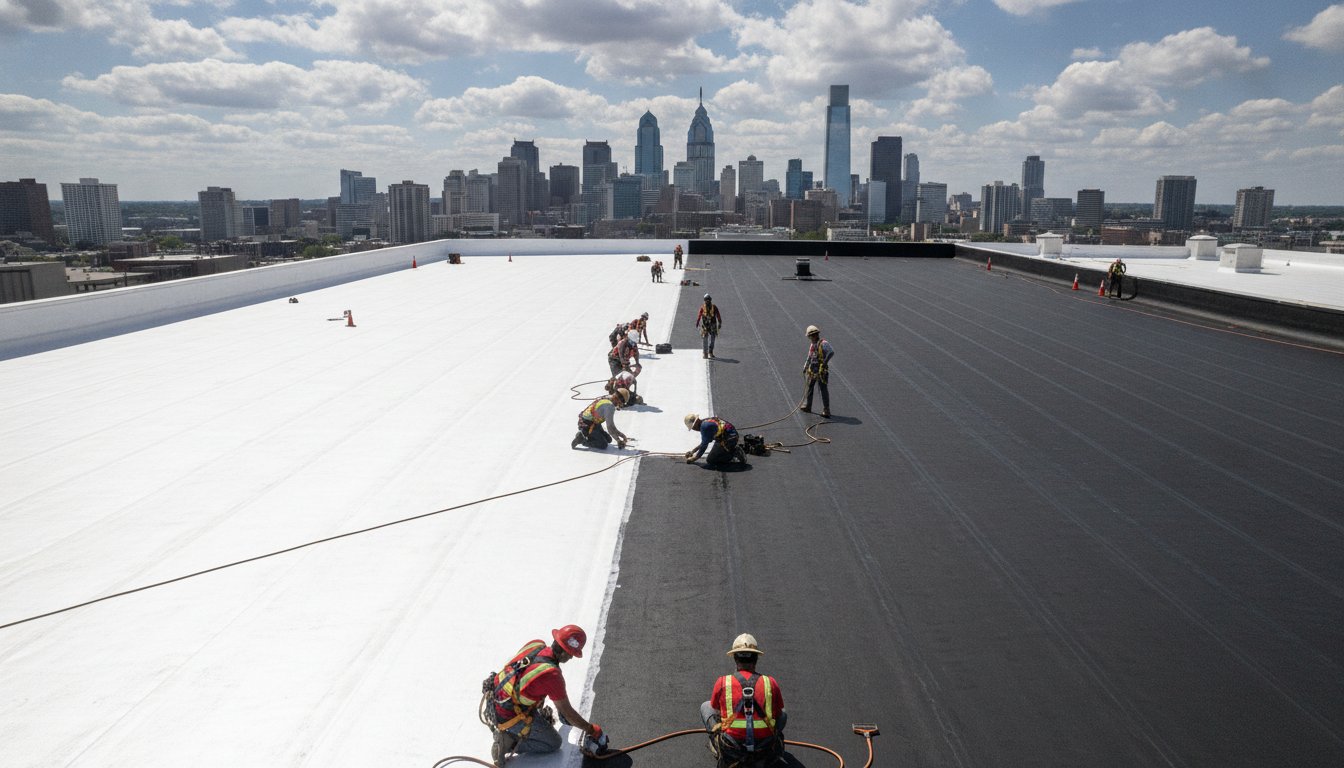
Summer shifts the tactical advantage toward TPO. The "Cool Roof" effect is a primary driver for ROI in modern facilities. White membranes reflect the majority of solar radiation. This lowers your facility’s peak energy demand and significantly reduces the wear on rooftop HVAC units. EPDM "Black Roofs" act as massive heat sinks. On a 90-degree Philadelphia day, a black membrane can reach 160 degrees. This heat transfers directly into the building core, driving up cooling costs and stressing mechanical equipment. Choosing between white, grey, and black membranes requires a calculated balance of winter drainage benefits and summer energy savings. Secure your facility against PA’s extreme cycles by visiting prestigeopsusa.com for a tactical damage assessment of your current system.
Executing the Install: Prestige Operations Standards
The strategic choice between TPO vs EPDM roofing Philadelphia is only the first step in protecting your building shell. Real asset security comes from the precision of the installation. General contractors often treat industrial roofing as a simple materials swap. We treat it as a logistical operation. Our "boots-on-the-ground" approach ensures that every weld and adhesive bond meets a rigorous standard of performance. We operate with a level of precision that eliminates the vulnerabilities typical of large-scale projects. Your roof is the primary defense for your property's liquidation value.
Tactical damage assessment protocols are the foundation of our process. Before a single roll of membrane is unloaded, we perform a forensic evaluation of the existing deck and drainage systems. This data-driven approach ensures that the selected system actually addresses the specific failures of your current facility. Whether we are deploying heat-welded TPO in Allentown or installing flexible EPDM in Collegeville, our specialized labor force works with methodical efficiency. We don't guess. We execute based on the technical requirements of the building. This discipline ensures the integrity of the building envelope from the perimeter to the most complex rooftop penetrations.
Industrial-Strength Reliability
Complex, large-scale requirements don't phase us. We specialize in high-stakes environments where operational downtime isn't an option. Our project management is decisive and direct. We move quickly to secure the envelope, minimizing the impact on your daily operations. This speed doesn't come at the cost of quality. It comes from logistical mastery and a disciplined workflow. We maintain strict control over every phase of the project, from material staging to the final inspection of the heat-welded seams. This results-driven focus is why we are the preferred partner for facility managers across the Northeast who demand reliability over empty promises.
Next Steps for Facility Integrity
Protecting your industrial asset requires a proactive strategy. Waiting for a visible leak is a reactive failure that leads to expensive structural damage and inventory loss. Schedule a forensic roof inspection for your Allentown or Reading property to identify hidden vulnerabilities before they escalate. We provide a comprehensive comparison tailored to your building shell, factoring in exhaust profiles, foot traffic, and thermal loads. Secure your asset with professional roofing mastery. Visit prestigeopsusa.com to initiate a tactical value assessment and lock in a leak-free facility for the next two decades.
Securing Your Facility’s Operational Future
Industrial roofing selection is a tactical asset management decision. You've analyzed the technical performance of TPO vs EPDM roofing Philadelphia. You understand that TPO's heat-welded seams provide a monolithic bond, while EPDM's elasticity survives the most brutal Pennsylvania winters. The choice depends on your facility's specific exhaust profile and energy requirements. Precision execution remains the only variable that guarantees a 20-year leak-free lifespan. We provide industrial-strength reliability through logistical mastery in PA commercial roofing. Our tactical asset protection standards ensure your building remains a high-value asset rather than a maintenance liability.
General contracting lacks the technical specialization required for high-stakes roofing projects. Our specialized labor force focuses on the logistical reality of large-scale infrastructure. We prioritize the structural integrity of your building envelope to ensure long-term ROI. Don't leave your building's envelope to chance. Professional execution is the difference between a secure facility and a depreciating property. Secure Your Industrial Asset with a Tactical Roofing Estimate. We are ready to deploy the technical expertise your project demands. Your roof is your first line of defense; make it an impenetrable one.
Frequently Asked Questions
Is TPO or EPDM better for Philadelphia weather?
Both systems perform well, but they serve different thermal strategies. TPO is the tactical choice for summer heat mitigation due to its high solar reflectivity. EPDM is the superior winter performer because it maintains elasticity during sub-zero Philadelphia nights. Choosing between TPO vs EPDM roofing Philadelphia requires balancing energy savings against long-term material flexibility. We evaluate your facility's specific micro-climate before recommending a specialized single-ply system.
How much does a commercial TPO roofing installation cost in Allentown PA?
Commercial roofing costs depend on the complexity of the building shell and local labor requirements. Factors like the type of insulation, the number of penetrations, and the existing deck condition drive the final investment. You should consult a specialized contractor for a site-specific assessment rather than relying on generic estimates. We focus on providing a data-driven comparison that accounts for long-term ROI rather than just the initial installation price.
Can I install a TPO membrane over an existing EPDM roof?
You can often install TPO over an existing EPDM system using a recover strategy. This requires a high-density cover board to separate the two membranes. It prevents chemical incompatibility and provides a smooth surface for the new heat-welded seams. A forensic inspection is mandatory to ensure the existing substrate is dry and structurally sound. This approach reduces tear-off labor and keeps your facility operational during the installation process.
What is the average lifespan of an industrial EPDM roof in Reading?
An industrial EPDM roof typically provides a service life of 25 to 30 years in the Reading area. Its synthetic rubber composition is highly resistant to UV degradation and thermal shock. Regular inspections and proactive seam maintenance are necessary to reach this maximum lifespan. Without tactical oversight, adhesive failure can shorten this window significantly. Precision in the initial execution is the primary driver of long-term durability for these rubber systems.
How do heat-welded seams compare to taped seams in flat roofing?
Heat-welded seams are molecularly fused to create a physical bond stronger than the membrane itself. Taped seams rely on high-grade adhesives and primers to create a chemical seal. While both are effective, welded seams offer superior resistance to wind uplift and mechanical stress. Robotic welding ensures consistent integrity across large industrial acreages. Adhesive systems require stricter environmental windows for optimal bonding during the installation phase to prevent premature failure.
Does TPO roofing really lower energy bills for Pennsylvania warehouses?
TPO significantly lowers summer energy bills by reflecting solar radiation away from the building. This reduces the heat load on your HVAC units and stabilizes internal warehouse temperatures during humid Pennsylvania months. While it doesn't offer the same winter heat absorption as black EPDM, the net energy ROI for large-scale facilities is often decisive. Reducing peak demand charges can lead to substantial overhead savings for high-stakes industrial operations.
What maintenance is required for an industrial flat roof in Collegeville?
Industrial maintenance requires semi-annual inspections to clear debris and verify drainage flow. You must check for seam separation, flashing degradation, and punctures around mechanical equipment. In Collegeville, clearing snow and ice from primary drains is critical to prevent structural deflection from dead weight. A tactical damage assessment protocol helps identify minor issues before they become catastrophic failures. Consistent exterior maintenance is the only way to protect your property's liquidation value.
Is EPDM more puncture-resistant than TPO for heavy foot traffic?
TPO generally offers higher puncture resistance than standard EPDM because it is a reinforced thermoplastic. It handles the mechanical stress of heavy foot traffic and equipment maintenance with greater integrity. EPDM is a softer rubber that can be more susceptible to cuts from dropped tools or sharp debris. If your roof serves as a high-traffic platform for HVAC units or solar arrays, TPO is the more durable tactical choice for the building envelope.